
USD


Benzocaine powder (CAS 94-09-7) is a well-known organic compound used in laboratory research and formulation studies. Today, it remains one of the most frequently selected ester-type substances in R&D environments.
Because of its stable crystalline structure and consistent purity profile, many laboratories prefer it for controlled experiments. In addition, its predictable physical properties make it suitable for analytical testing and formulation development.
Moreover, global demand continues to grow. Research facilities in the UK, Ireland, Germany, France, USA, Canada, Australia, New Zealand, Sweden, Estonia, Hungary, Romania, Spain, Italy, and Mexico increasingly require certified supply chains and safe worldwide delivery.
Therefore, understanding its properties, forms, and sourcing criteria is essential in 2026.
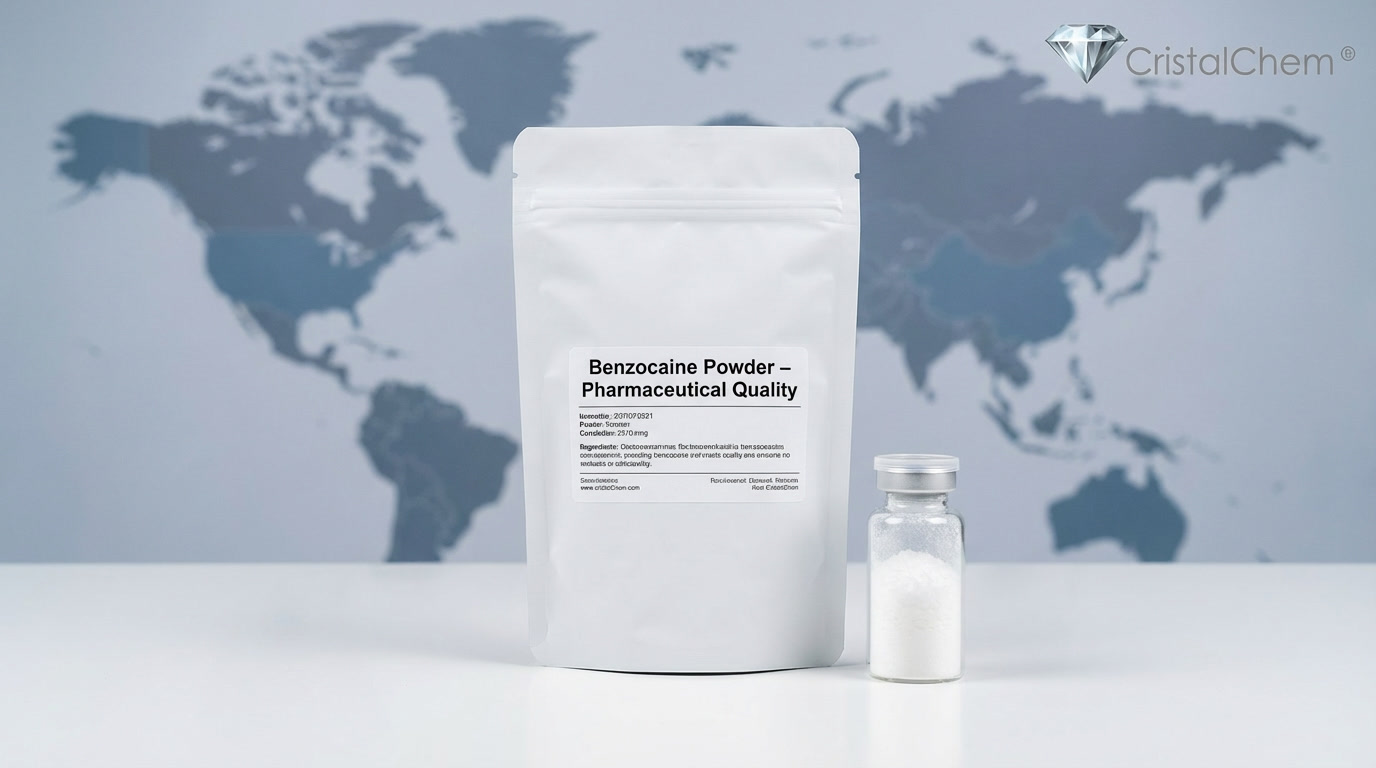
Benzocaine is chemically known as ethyl 4-aminobenzoate. It belongs to the ester group.
Its molecular formula is C9H11NO2, and its molecular weight is 165.19 g/mol.
Under standard laboratory conditions, benzocaine appears as:
Furthermore, it has low solubility in water but dissolves more easily in ethanol and certain organic solvents. As a result, researchers often select appropriate solvent systems depending on the experimental design.
Many buyers ask about the difference between mesh and fluffy forms. However, the chemical composition remains identical in both cases.
The difference lies in physical structure.
Mesh refers to particle size distribution. In practice, this means the powder has a more standardized granulation.
Because of this, mesh powder:
Therefore, laboratories performing analytical measurements often choose mesh form.
Fluffy powder, on the other hand, has lower bulk density. It appears lighter and more aerated.
As a result, it behaves differently during blending and dispersion. For example, formulation teams sometimes prefer fluffy form for texture and mixing studies.
Nevertheless, both forms share the same CAS number and chemical structure.
Benzocaine powder is widely used in several research environments.
First, it plays a role in analytical validation. Laboratories may use it as a reference compound when testing purity or stability.
Second, it is used in formulation research. Cosmetic and topical R&D teams study dispersion, solubility, and stability behavior.
In addition, academic institutions use benzocaine when teaching ester chemistry and organic structure comparison.
Therefore, the compound remains relevant in both commercial and academic settings.
In recent years, demand for research-grade ester compounds has increased steadily. This trend is visible across Europe and North America.
For instance, laboratories in the UK, Ireland, Germany, Netherlands, France, Belgium, Spain, Italy, Sweden, and Central Europe continue expanding analytical capacity. At the same time, the USA and Canada remain strong procurement markets.
Moreover, Australia and New Zealand show growth in laboratory infrastructure. As a result, international supply chains must operate efficiently.
Consequently, suppliers offering verified documentation and safe worldwide delivery are gaining competitive advantage.
When sourcing benzocaine powder, several factors matter.
First, purity level should be clearly documented. Most research environments prefer ≥99.9% purity.
Second, suppliers should provide COA and SDS documentation. This ensures compliance with UK and EU chemical trade regulations.
Third, batch consistency is critical. Without it, experimental reproducibility may suffer.
Therefore, laboratories increasingly prioritize transparent and reliable suppliers.
Proper storage improves long-term stability.
For best results:
Additionally, use calibrated scales when handling research quantities. This reduces measurement variation.
Benzocaine powder (CAS 94-09-7) remains a widely used ester compound in laboratory and formulation research. Although mesh and fluffy forms differ in physical structure, their chemical identity remains the same.
In 2026, global demand continues to grow. Therefore, sourcing high-purity material with proper documentation and safe worldwide delivery is essential for reliable experimental outcomes.

Chemical Research Writer at CristalChem Academy. Passionate about chemistry, R&D, and turning laboratory insights into global wellness and industrial innovations.