
USD

Benzocaine tattoo gel refers to a gel-based research system that contains benzocaine (CAS 94-09-7) for laboratory evaluation. Although the compound itself appears in many scientific databases, its behavior inside semi-solid structures requires separate testing. For that reason, researchers study how benzocaine disperses, stabilizes and reacts within gel matrices.
Instead of focusing on marketing claims, laboratories examine measurable parameters. For example, they test particle distribution, solvent interaction and temperature stability. As a result, scientists gain practical insight into how crystalline material behaves in controlled conditions.
You can verify core chemical data here:
PubChem – Benzocaine
https://pubchem.ncbi.nlm.nih.gov/compound/2337
ChemSpider – Structural data
http://www.chemspider.com/Chemical-Structure.2337.html
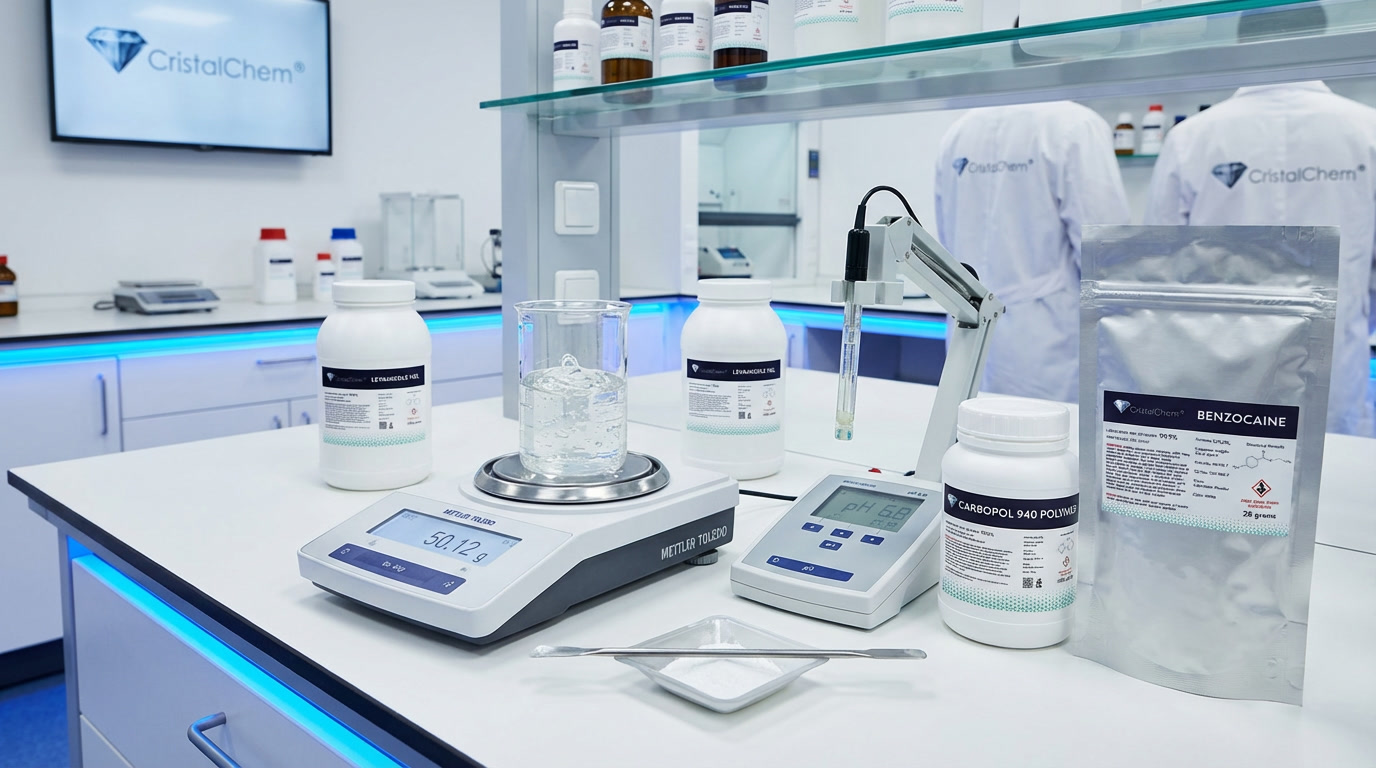
Gel systems support structured laboratory testing. First, they provide adjustable viscosity. Second, they help distribute particles evenly. In addition, they allow researchers to monitor stability over time.
Because benzocaine has low water solubility, hydroalcoholic systems often produce better dispersion. Therefore, solvent ratio becomes a central factor. At the same time, pH balance affects crystallization risk. If the environment becomes too acidic or too alkaline, stability decreases.
Across the United Kingdom, Germany, France, Italy and the Netherlands, topical R&D activity continues to grow. Meanwhile, demand increases in the USA, Canada and Australia. Consequently, laboratories depend on stable supply chains supported by safe worldwide delivery.
Before preparing any experimental gel, researchers confirm essential compound data.
CAS Number: 94-09-7
Molecular Formula: C9H11NO2
Melting Range: 88–90°C
Water Solubility: Low
Ethanol Solubility: Moderate
According to the NIST WebBook, benzocaine shows consistent melting behavior under controlled conditions. Therefore, laboratories verify melting range before dispersion testing.
NIST Reference:
https://webbook.nist.gov
For laboratory-grade material:
🔵 Benzocaine Powder – CAS 94-09-7
https://www.cristalchem.com/product/benzocaine-powder/
Each batch includes documentation and safe worldwide delivery.
In research environments, scientists design gel systems to evaluate stability rather than market performance. Typically, a base includes a polymer matrix combined with an ethanol-water mixture. After that, researchers introduce benzocaine under controlled mixing conditions.
However, multiple factors influence the final result. Temperature affects crystallization behavior. Likewise, solvent polarity changes dispersion speed. Furthermore, storage conditions determine long-term consistency.
To maintain reproducibility, laboratories store samples below 25°C and protect them from humidity. In addition, they document each parameter during testing.
Particle form directly affects dispersion behavior.
Mesh powder offers uniform particle size. As a result, distribution inside gel matrices becomes more predictable. In contrast, fluffy powder presents higher surface area. Therefore, it may influence dissolution speed under certain solvent conditions.
Selection depends on the goal of the experiment. If stability testing is the priority, researchers often prefer uniform mesh structures. On the other hand, if surface interaction studies are conducted, alternative forms may be examined.
Related compounds used in comparative research include:
🔵 Lidocaine HCl
https://www.cristalchem.com/product/lidocaine-hcl/
🔵 Procaine HCl
https://www.cristalchem.com/product/procaine-hcl/
The tattoo industry has expanded steadily over the past decade. Consequently, interest in gel-based topical systems has increased. Markets showing strong growth include:
United Kingdom
Germany
France
Italy
Spain
Sweden
USA
Canada
Australia
New Zealand
Industry insights are available via:
Statista – Market Data
https://www.statista.com
DataIntelo – Industry Research
https://dataintelo.com
Because global demand continues to rise, laboratories require consistent sourcing backed by safe worldwide delivery.
Proper storage preserves chemical stability. Laboratories keep benzocaine powder below 25°C. They also minimize moisture exposure. Furthermore, sealed packaging reduces contamination risk.
During international transport, documentation must accompany every shipment. Therefore, suppliers provide COA and SDS files with each batch. When research operations span across borders, structured logistics protect material integrity.
For this reason, sourcing from a supplier that guarantees safe worldwide delivery reduces operational uncertainty.
It describes experimental gel systems that contain benzocaine for stability and dispersion testing.
They provide better control over viscosity and particle distribution.
Yes. Mesh and fluffy structures influence homogeneity and dispersion speed.
Yes. CristalChem offers verified material with documentation and safe worldwide delivery.