
USD

Benzocaine powder (CAS 94-09-7) is a high-purity ester compound widely used in laboratory research, analytical validation, and formulation development. Due to its stable chemical structure and predictable physical behavior, it remains one of the most frequently selected reference substances in controlled R&D environments.
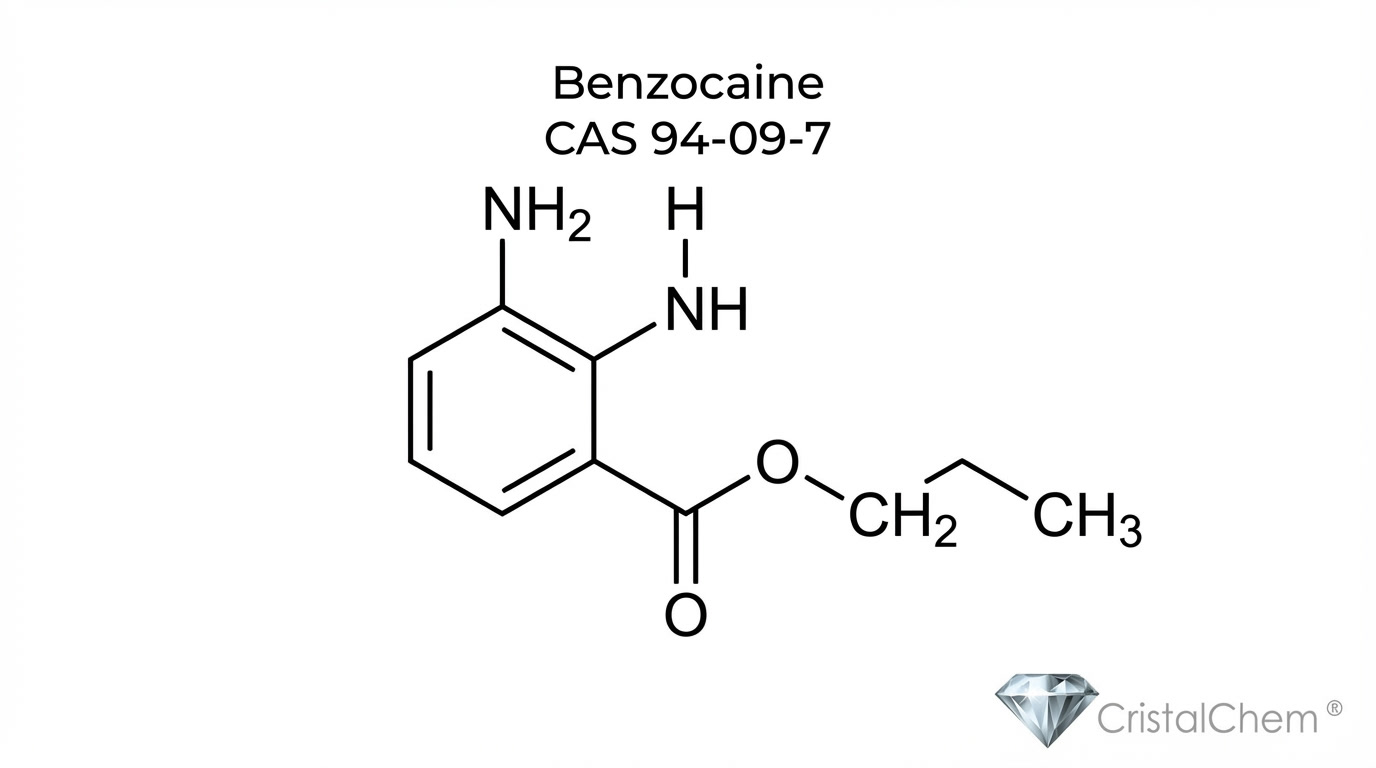
It appears as a white to slightly yellow crystalline powder and is available in mesh and fluffy forms depending on particle distribution requirements. Laboratories in the UK, Ireland, Germany, France, USA, Canada, Australia, New Zealand, Sweden, Italy, Spain, Netherlands, Belgium, and other international markets rely on consistent supply chains and documented purity levels.
Moreover, certified sourcing with COA and SDS documentation ensures regulatory compliance and safe worldwide delivery for professional laboratory and industrial use.
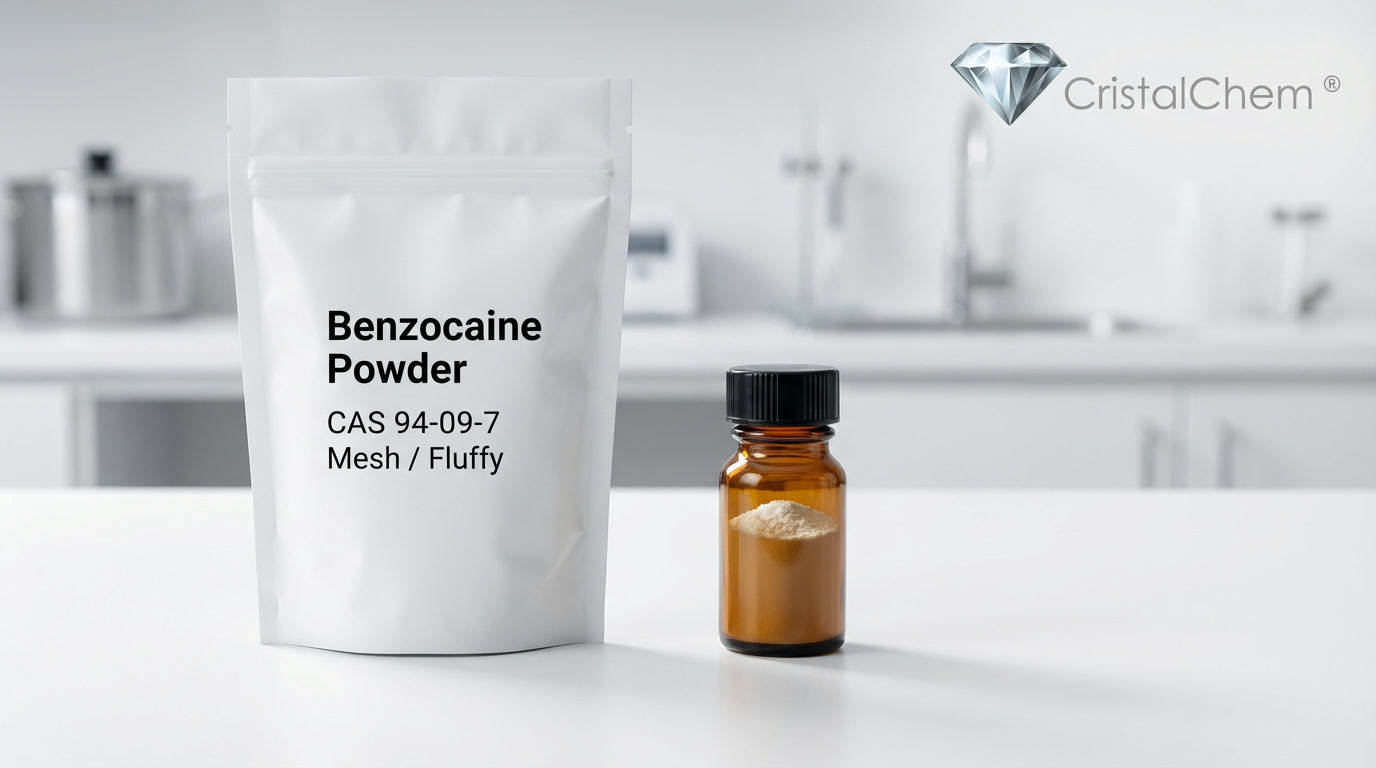
Understanding the difference between benzocaine powder mesh and benzocaine powder fluffy is essential for laboratories and formulation teams. Although both forms share the same chemical structure (CAS 94-09-7), their physical characteristics differ significantly.
Mesh refers to controlled particle size distribution. In practical terms, this means the powder has a more uniform and standardized granulation.
As a result, mesh form offers:
Therefore, benzocaine powder mesh is typically selected for chromatographic validation, dissolution studies, and laboratory environments where measurement accuracy is critical.
Fluffy form, on the other hand, has lower bulk density and a lighter, more aerated structure. While the chemical identity remains identical, the physical handling experience changes.
Consequently, fluffy benzocaine powder is often preferred in:
Because of its lower density, fluffy form may occupy more volume per gram compared to mesh material.
| Feature | Mesh Form | Fluffy Form |
|---|---|---|
| Particle Structure | Standardized | Light & Aerated |
| Flow Behavior | More Controlled | Softer Handling |
| Bulk Density | Higher | Lower |
| Typical Use | Analytical Testing | Formulation Research |
Both forms are chemically identical. The selection depends on experimental requirements rather than molecular differences.

Benzocaine powder (CAS 94-09-7) is widely used across multiple research and industrial environments. Although it is a single chemical compound, its application range varies depending on laboratory objectives and formulation requirements.
First, benzocaine powder is frequently used as a reference compound in analytical validation. Because of its stable ester structure and predictable solubility behavior, it performs well in chromatographic calibration and dissolution testing.
For example, laboratories may use it when validating analytical methods or testing batch consistency. As a result, mesh form is often preferred in precision-driven environments.
In addition, benzocaine powder plays a role in formulation research. Cosmetic and topical development teams may study its dispersion behavior, stability in emulsions, and interaction with carrier systems.
Moreover, fluffy form can be useful in blending experiments where bulk density and texture influence final formulation characteristics.
Universities and research institutions also use benzocaine powder in organic chemistry programs. Since it belongs to the ester compound class, it is commonly referenced when comparing ester vs amide structures in laboratory exercises.
Furthermore, industrial research facilities in the UK, Germany, France, Netherlands, Italy, Spain, Sweden, USA, Canada, Australia, New Zealand, Hungary, Romania, and Mexico continue expanding analytical infrastructure. Consequently, demand for certified laboratory-grade compounds remains stable.
Benzocaine is frequently compared with other research compounds such as:
Because molecular structure directly influences solubility and reactivity behavior, comparative studies help laboratories select the most appropriate compound for specific research objectives.
Across all these applications, sourcing from a verified supplier with documented purity, COA availability, and safe worldwide delivery ensures reproducibility and compliance with international laboratory standards.
The global demand for benzocaine powder (CAS 94-09-7) continues to show stable growth in 2026. Although it is a specialized compound, expansion of laboratory infrastructure and formulation research across Europe and North America drives consistent procurement activity.
In recent years, several factors have influenced demand:
As a result, procurement teams prioritize suppliers offering documented purity, transparent batch traceability, and safe worldwide delivery.
Demand is particularly visible in:
Because international research collaboration has increased, laboratories often require cross-border shipping with compliant documentation. Therefore, certified global suppliers gain competitive advantage in regulated markets.
In 2026, buyers increasingly compare:
Consequently, online visibility for phrases such as “buy benzocaine powder”, “benzocaine powder supplier”, and “benzocaine powder price” has become strategically important for both laboratories and independent research units.
This evolving landscape confirms that benzocaine powder remains a relevant compound in laboratory procurement strategies worldwide.
When sourcing benzocaine powder (CAS 94-09-7), quality standards and documentation are critical. Although the chemical structure may remain identical across suppliers, purity levels, batch consistency, and regulatory compliance often vary significantly.
Therefore, laboratories and research buyers should evaluate several key factors before purchasing.
First, verify the declared purity level. In most professional environments, ≥99.9% purity is preferred for analytical reliability and formulation stability.
In addition, batch-to-batch consistency ensures reproducible results. Without it, experimental outcomes may vary unexpectedly. Consequently, transparent batch traceability becomes essential for serious research applications.
A reliable supplier must provide:
Moreover, accessible documentation simplifies compliance with UK, EU, and international laboratory standards.
Because cross-border research collaboration has increased, shipping reliability is equally important. Laboratories in the United Kingdom, Ireland, Germany, France, Netherlands, Spain, Italy, Sweden, USA, Canada, Australia, New Zealand, and Central Europe often require documented safe worldwide delivery.
Therefore, selecting a supplier that combines purity verification with stable logistics infrastructure reduces procurement risk.
In 2026, transparency has become a decisive factor. Buyers increasingly compare:
As a result, trusted suppliers with clearly structured product information and compliance documentation stand out in competitive markets.
Although benzocaine powder (CAS 94-09-7) is widely used in laboratory research, it is often compared with other structurally related compounds such as lidocaine HCl and procaine HCl. While these substances may appear similar at first glance, their chemical classification and research behavior differ.
Understanding these differences helps laboratories select the most appropriate compound for specific analytical or formulation objectives.
Because ester and amide structures behave differently under certain experimental conditions, compound selection may influence solubility, stability, and reaction pathways.
| Feature | Benzocaine | Procaine HCl | Lidocaine HCl |
|---|---|---|---|
| Chemical Class | Ester | Ester | Amide |
| CAS Number | 94-09-7 | 51-05-8 | 73-78-9 |
| Water Solubility | Low | Moderate | Higher |
| Common Research Focus | Analytical validation | Ester comparison | Solubility & structure studies |
| Physical Form | Powder (Mesh / Fluffy) | Powder | Crystalline powder |
First, ester compounds such as benzocaine and procaine share similar structural characteristics. However, minor differences in molecular composition can influence stability and degradation pathways.
In contrast, lidocaine belongs to the amide class. Therefore, its behavior under hydrolysis and certain solvent systems may differ.
Consequently, laboratories often compare these compounds when studying:
This comparative context strengthens procurement decisions, especially when sourcing from global suppliers offering documented purity and safe worldwide delivery.
Benzocaine powder (CAS 94-09-7) is commonly used in laboratory research, analytical validation, and formulation studies. Because of its stable ester structure, it performs consistently in controlled testing environments. In addition, laboratories often use it as a reference compound when evaluating solubility, purity, and stability behavior.
The CAS number of benzocaine is 94-09-7. This identifier ensures accurate chemical classification and prevents confusion with structurally related compounds. Therefore, buyers should always verify CAS documentation when sourcing laboratory-grade material.
The difference lies in physical structure rather than chemical composition. Mesh form has standardized particle size distribution, which improves weighing precision and flow behavior. Fluffy form, on the other hand, has lower bulk density and a lighter structure, which may influence blending and dispersion testing.
Benzocaine powder has low solubility in water. However, it dissolves more effectively in ethanol and certain organic solvents. As a result, researchers typically select appropriate solvent systems based on experimental design requirements.
For optimal stability, benzocaine powder should be stored in a cool, dry place away from direct light and moisture. In addition, containers should remain tightly sealed to prevent contamination or humidity exposure.
Most professional research environments prefer ≥99.9% purity. High purity ensures reproducible analytical results and reduces variability in formulation studies. Therefore, documented COA verification is essential.
Yes. A reliable supplier should provide a Certificate of Analysis (COA) and Safety Data Sheet (SDS). These documents support regulatory compliance and safe handling in laboratory settings.
Certified suppliers offer safe worldwide delivery, including regions such as the United Kingdom, Ireland, Germany, France, Netherlands, Spain, Italy, Sweden, USA, Canada, Australia, New Zealand, Hungary, Romania, and Mexico. However, documentation and compliance standards should always be verified before purchase.
Benzocaine belongs to the ester class, whereas lidocaine is classified as an amide compound. Because structural classification influences certain chemical behaviors, laboratories often compare these compounds when conducting analytical or formulation research.
Batch consistency ensures reproducible experimental results. Without consistent manufacturing standards, analytical outcomes may vary. Consequently, transparent batch traceability is a key procurement factor.
If you are looking to buy benzocaine powder with documented purity and reliable logistics, explore our available options below. We provide certified laboratory-grade material with COA and SDS documentation and safe worldwide delivery across Europe, North America, and international markets.
Available products:
• Buy Benzocaine Powder Mesh
• Buy Benzocaine Powder Fluffy
• Buy Lidocaine HCl
• Buy Levamisole HCl
• Buy Boric Acid Flake
• Buy Phenacetin Powder