
USD


Procaine Hydrochloride (Procaine HCl) remains one of the most frequently used laboratory reagents in 2026, known for its stability, reliability, and broad use in research formulations. Because laboratories worldwide need safe, compliant, and fully documented reagents, the understanding of how and where Procaine HCl is applied has become essential for both R&D and production environments.
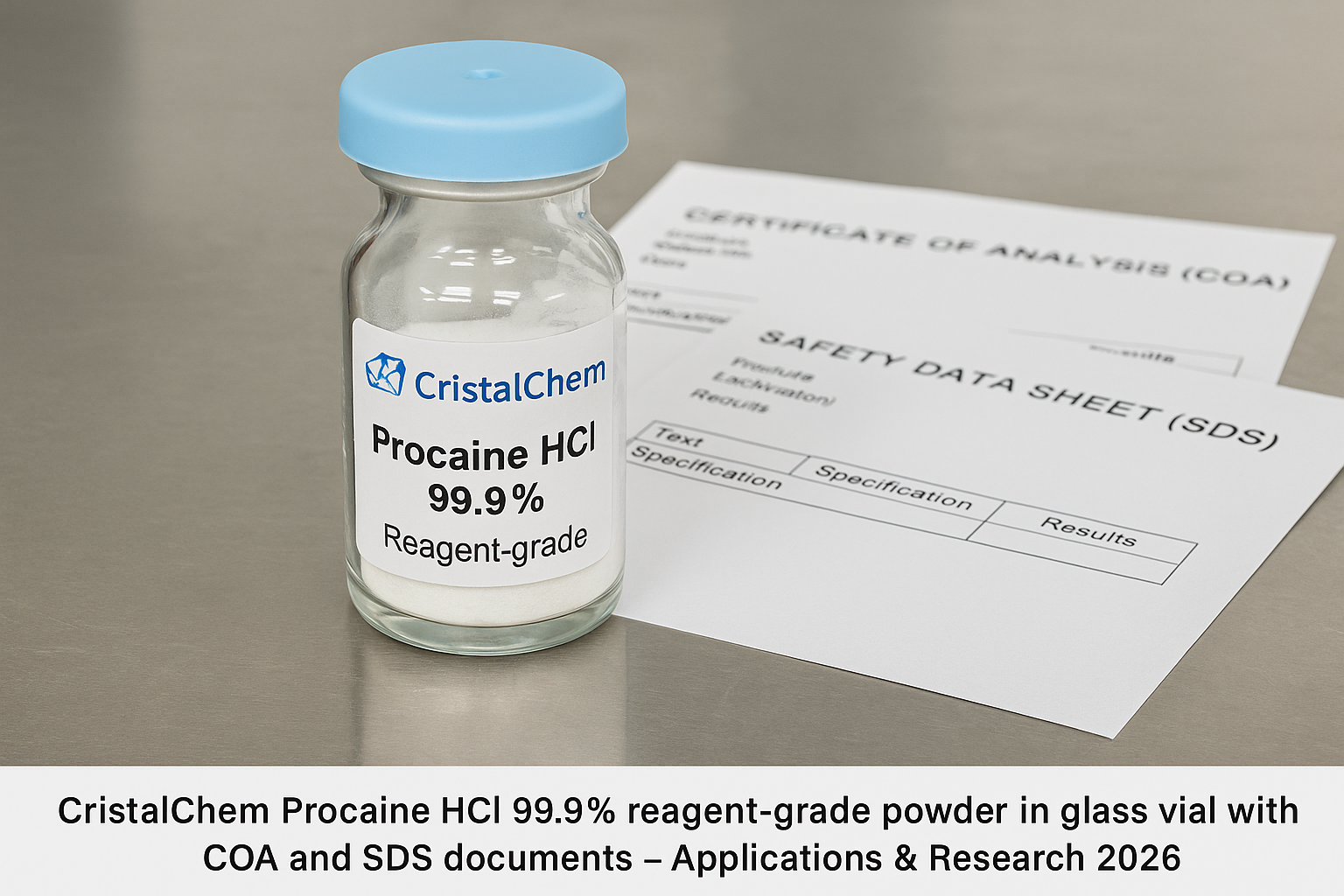
In many modern laboratories, Procaine HCl 99.9% reagent grade is applied as a benchmark compound in the study of local anaesthetic analogues. Its consistent solubility and neutral pH behavior make it suitable for reference testing in analytical and chromatographic systems.
Researchers often use Procaine HCl alongside Benzocaine or Boric Acid in comparative formulation tests. For example, when evaluating solvent stability and pH buffer compatibility, Procaine offers a clear analytical advantage due to its lower volatility and precise titration curve.
Moreover, Procaine HCl’s high purity level and consistent melting range make it useful for quantitative calibration in GC-MS and HPLC environments.
Procaine HCl has long been a foundation compound in the creation of topical anaesthetics and surface numbing gels. Because of its controlled absorption rate, it serves as a model active for emulsion and hydrogel development.
Pharmaceutical formulators typically test Procaine HCl alongside Benzocaine-based creams and gels to optimize the ratio between onset time and durability. In addition, R&D teams use the compound in prototype formulations where pH sensitivity and solvent interaction must remain consistent across repeated trials.
As a result, Procaine HCl functions not only as a test reagent but also as a stability marker in cross-phase emulsion research. For this reason, many laboratories have moved to use certified suppliers like CristalChem, ensuring every batch includes validated COA and SDS documentation.
In the field of analytical chemistry, Procaine HCl acts as an internal standard during pKa calibration and chemical purity testing. Because of its consistent ionization profile, it performs predictably in both aqueous and mixed organic media.
Quality control teams in pharmaceutical laboratories often choose Procaine HCl as a control sample due to its stability under controlled humidity and temperature conditions. Therefore, it helps confirm the accuracy of batch assays and retention times in chromatographic instruments.
In regulatory testing, Procaine HCl also serves as a comparative marker when validating SDS or REACH labeling. More information on compliance labeling can be found in CristalChem’s Safety Data Sheet guide.
In 2026, many cosmetic and dental laboratories use Procaine HCl to research non-clinical desensitizing formulations. For instance, it is often combined with cooling agents such as menthol to evaluate sensory thresholds and controlled release properties.
In industrial applications, Procaine serves as a comparative active when testing gel viscosities and polymer stability in pharmaceutical-grade emulsions. This process mirrors work done with Benzocaine safety studies, ensuring consistent R&D safety controls and environmental handling procedures.
Because laboratories demand full traceability, CristalChem provides complete documentation with each shipment, including batch-level COA, SDS, and REACH registration data.
Every batch of Procaine HCl supplied by CristalChem meets the requirements of ECHA REACH and FDA laboratory import guidelines. Therefore, laboratories can use it safely for analytical and formulation research.
According to the European CLP regulation (1272/2008), Procaine HCl is classified as a research reagent, not for human or veterinary use. Consequently, handling should always follow SDS precautions and use in certified laboratory environments.
Those involved in reagent storage or labeling verification can refer to CristalChem’s practical comparison guide: Benzocaine, Lidocaine & Procaine — Comparative Overview.
⚠️ Disclaimer: All information provided in this article is intended solely for scientific, educational and research purposes! The data, specifications and analytical notes are based on available laboratory literature and internal R&D testing. CristalChem does not guarantee completeness or absolute accuracy of the information presented — users should independently verify all details before use in their own research environment. All reagents mentioned are strictly for laboratory and R&D applications only. Not for human or veterinary use!

Chemical Research Writer at CristalChem Academy. Passionate about chemistry, R&D, and turning laboratory insights into global wellness and industrial innovations.