
USD




$67.38
In stock
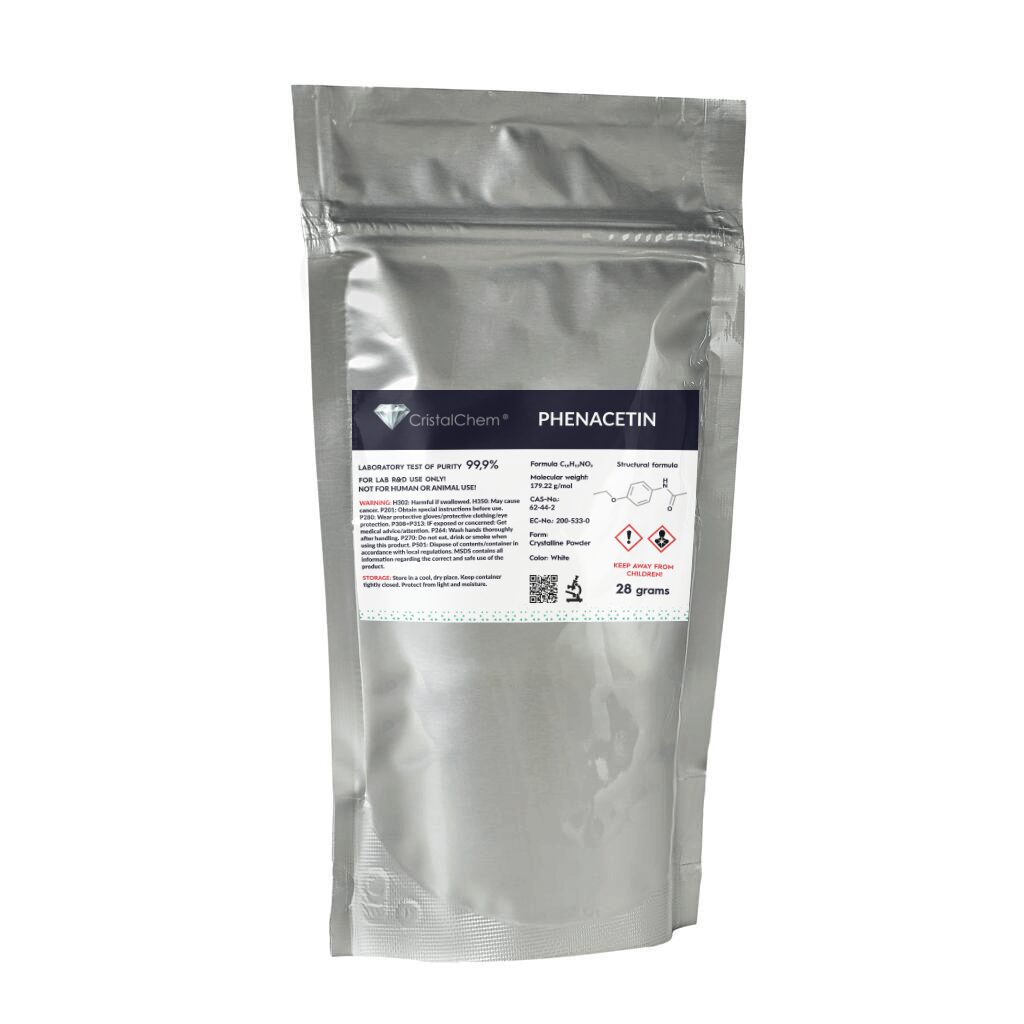
Phenacetin Pure – Purity ≥99.9%
Packaging: Aluminium doypack
Weight: 28g
Safety: Securely sealed packaging
Appearance: White crystalline powder
CAS No.: 62-44-2
EC No.: 200-533-0
Type: Certified Product
Product: Organic chemical for laboratory use
Phenacetin is an organic compound from the acetanilide group. Historically used as a painkiller and fever reducer, it is now applied exclusively in research and development. Today, it is primarily a reference standard in toxicological, pharmacological, and analytical studies, as well as in teaching and industrial R&D projects.
⚠️ FOR LAB R&D USE ONLY!
| Parameter | Value / Description |
|---|---|
| Form | Solid crystalline powder |
| Color | White |
| Odor | Practically odorless |
| Taste | Slightly bitter |
| Chemical formula | C₁₀H₁₃NO₂ |
| Molar mass | 179.22 g/mol |
| Melting point | 134–136 °C |
| Boiling point | ~132 °C at 0.04 mmHg (decomposes) |
| Density | 1.24 g/cm³ |
| Solubility in water | Very low (0.076 g/100 mL at 25 °C) |
| Solubility in organic solvents | Readily soluble in ethanol, chloroform, acetone, benzene, ether |
H302: Harmful if swallowed.
H361: Suspected of damaging fertility or the unborn child.
H373: May cause organ damage (kidneys, liver) through prolonged exposure.
P260: Do not breathe dust.
P280: Wear protective gloves and eye protection.
P301 + P312: If swallowed: call a poison center or doctor.
P501: Dispose of contents/container in accordance with local regulations.
Storage: Keep tightly closed, in a dry, cool place, protected from sunlight and humidity.
For laboratory and R&D use only. Not for human or veterinary use.
Phenacetin belongs to the acetanilide group of organic compounds. Inside the body, it converts to paracetamol (acetaminophen), which inhibits prostaglandin synthesis in the central nervous system. Consequently, this reduces pain perception and fever.
Unlike NSAIDs, phenacetin shows only weak anti-inflammatory activity. However, because of its potential toxicity, it is no longer used in therapy. Today, scientists study it only as a reference and model compound in laboratory work.
Historically, phenacetin served as an over-the-counter painkiller. In current research, it helps model acetanilide metabolism and analyze toxicological pathways.
Moreover, scientists use it to study oxidative stress and biochemical markers of kidney and liver injury.
In toxicology, phenacetin acts as a test compound for assessing drug safety. It allows researchers to examine carcinogenicity and nephropathy mechanisms, which makes it ideal for experimental modeling.
Researchers employ phenacetin as a reference standard in spectroscopy and chromatography (HPLC, GC).
It is also applied in crystallography, dissolution testing, and thermal stability experiments, where reproducible behavior is crucial.
Because its pharmacological profile is well defined, phenacetin is frequently used in teaching pharmacology and medicinal chemistry.
It clearly demonstrates how older, unsafe compounds evolved into safer modern drugs such as paracetamol.
Phenacetin dissolves only slightly in water but readily in ethanol, chloroform, acetone, benzene, and ether.
This combination of properties helps in preparing standard solutions for spectroscopy and chromatography, ensuring accurate calibration results.
Powder and tablets: once a common pain and fever remedy.
Combination formulations: used for decades in analgesic mixtures.
Replacement: fully replaced by paracetamol (acetaminophen) due to improved safety and lower toxicity.
Although withdrawn from clinical use, phenacetin remains important in:
reference laboratories, for calibrating analytical instruments,
pharmacological R&D, exploring metabolism and toxic pathways,
academic research, studying the evolution from early analgesics to safer alternatives.
Because of its stability and detailed toxicological data, it continues to serve as a benchmark substance in modern research.
For laboratory and R&D use only. Not for human or veterinary use.
| Weight | 0.03 kg |
|---|
| Cookie | Duration | Description |
|---|---|---|
| cookielawinfo-checkbox-advertisement | 1 year | Set by the GDPR Cookie Consent plugin, this cookie records the user consent for the cookies in the "Advertisement" category. |
| cookielawinfo-checkbox-analytics | 1 year | Set by the GDPR Cookie Consent plugin, this cookie records the user consent for the cookies in the "Analytics" category. |
| cookielawinfo-checkbox-functional | 1 year | The GDPR Cookie Consent plugin sets the cookie to record the user consent for the cookies in the category "Functional". |
| cookielawinfo-checkbox-necessary | 1 year | Set by the GDPR Cookie Consent plugin, this cookie records the user consent for the cookies in the "Necessary" category. |
| cookielawinfo-checkbox-non-necessary | 1 year | GDPR Cookie Consent plugin sets this cookie to record the user consent for the cookies in the "Necessary" category. |
| cookielawinfo-checkbox-others | 1 year | Set by the GDPR Cookie Consent plugin, this cookie stores user consent for cookies in the category "Others". |
| cookielawinfo-checkbox-performance | 1 year | Set by the GDPR Cookie Consent plugin, this cookie stores the user consent for cookies in the category "Performance". |
| CookieLawInfoConsent | 1 year | CookieYes sets this cookie to record the default button state of the corresponding category and the status of CCPA. It works only in coordination with the primary cookie. |
| elementor | never | The website's WordPress theme uses this cookie. It allows the website owner to implement or change the website's content in real-time. |
| Cookie | Duration | Description |
|---|---|---|
| mailchimp_landing_site | 1 month | MailChimp sets the cookie to record which page the user first visited. |
| pll_language | 1 year | Polylang sets this cookie to remember the language the user selects when returning to the website and get the language information when unavailable in another way. |
| Cookie | Duration | Description |
|---|---|---|
| _gat | 1 minute | Google Universal Analytics sets this cookie to restrain request rate and thus limit data collection on high-traffic sites. |
| Cookie | Duration | Description |
|---|---|---|
| _ga | 1 year 1 month 4 days | Google Analytics sets this cookie to calculate visitor, session and campaign data and track site usage for the site's analytics report. The cookie stores information anonymously and assigns a randomly generated number to recognise unique visitors. |
| _ga_* | 1 year 1 month 4 days | Google Analytics sets this cookie to store and count page views. |
| _gcl_au | 3 months | Google Tag Manager sets the cookie to experiment advertisement efficiency of websites using their services. |
| _gid | 1 day | Google Analytics sets this cookie to store information on how visitors use a website while also creating an analytics report of the website's performance. Some of the collected data includes the number of visitors, their source, and the pages they visit anonymously. |
| Cookie | Duration | Description |
|---|---|---|
| IDE | 1 year 24 days | Google DoubleClick IDE cookies store information about how the user uses the website to present them with relevant ads according to the user profile. |
| test_cookie | 15 minutes | doubleclick.net sets this cookie to determine if the user's browser supports cookies. |
| Cookie | Duration | Description |
|---|---|---|
| cookies.js | session | No description available. |
| woocommerce_recently_viewed | session | WooCommerce sets this cookie to store performed actions on the website. |