GBP


Every chemical reagent supplied by CristalChem — from benzocaine crystalline powder to caffeine anhydrous — comes with a Safety Data Sheet (SDS). But how do you actually read and interpret this document? The answer is crucial: an SDS is not just a formality. It is a fundamental tool that ensures safe handling, storage, and disposal of chemicals in laboratories, universities, and R&D centers worldwide.
At CristalChem, we serve scientists across UK, Ireland, Northern Ireland, Scotland, USA, Canada, Australia, New Zealand, Germany, Netherlands, Belgium, France, Spain, Italy, Sweden, Estonia, Latvia, Cyprus, Ibiza, Albania, Croatia, Hungary, Serbia, Romania, Bulgaria, Slovakia, Mexico, and beyond — always with compliant SDS and safe worldwide delivery.
✅ Buy Benzocaine crystalline powder – with compliant SDS
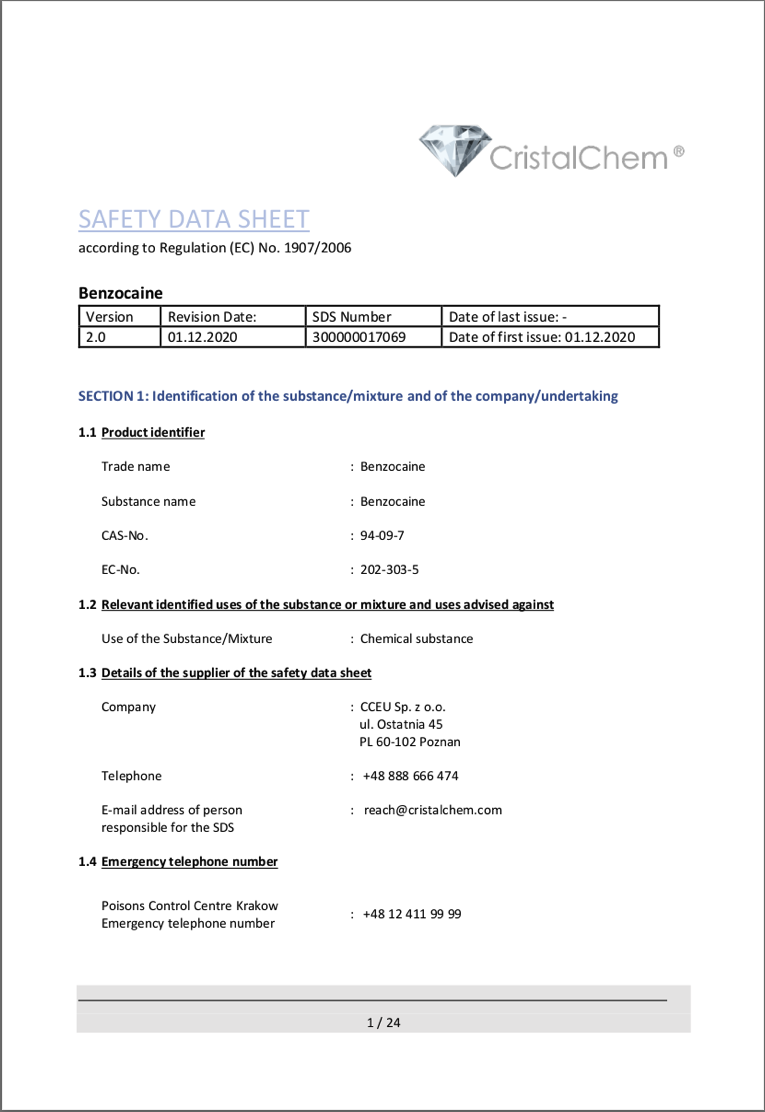
Safety Data Sheet SDS 16 sections CristalChem guide
An SDS (Safety Data Sheet) is a globally standardized document designed to provide essential information about chemicals. It is legally required under:
Every SDS follows a 16-section structure covering identification, hazards, composition, safe use, and disposal. It is a cornerstone of chemical safety in pharma, cosmetics, tattoo, wellness, and food-related industries.
The Safety Data Sheet format we know today is the result of decades of regulatory evolution. In the European Union, the REACH Regulation (Registration, Evaluation, Authorisation and Restriction of Chemicals) made SDS a binding requirement, harmonized with CLP (Classification, Labelling, Packaging). In the United States, OSHA’s Hazard Communication Standard (HazCom 2012) aligned with the UN GHS model, ensuring global consistency.
Today, scientists in Germany, France, Canada, Australia, and New Zealand all use the same 16-section SDS framework. This harmonization reduces errors, improves trade, and strengthens lab safety worldwide.
✅ Order Lidocaine HCl crystalline powder – pharma & R&D use
The SDS is structured into 16 globally recognized sections. Let us explore each in depth with CristalChem examples:
CAS numbers, EC numbers, trade names, recommended uses, supplier contact details. Example: PubChem — Benzocaine
Classification under GHS/CLP, GHS pictograms, H- and P-statements. Example: flammable solvents, toxic impurities.
Reference: UN GHS pictograms guide
Chemical identity, purity, stabilizers, impurities. For ChemSpider — Phenacetin, the database lists CAS, structure, and properties.
Step-by-step instructions for inhalation, skin/eye contact, ingestion. Referenced with NIOSH Pocket Guide.
Extinguishing media, hazards, PPE for firefighters. Examples: avoid water jets on solvent fires.
Containment, PPE, environmental precautions. Guidance for labs and storage areas.
Safe handling practices: minimize dust, ventilate, wear PPE. Storage: temperature/humidity, packaging integrity.
Lists exposure limits (OSHA PEL, ACGIH TLV), recommended gloves, goggles, lab coats, respirators.

SDS example vial CristalChem product with Safety Data Sheet
✅ Shop Paracetamol crystalline compound – with SDS
Sections 1–8 cover identification, hazards, composition, first-aid, firefighting, accidental release, handling, and exposure controls. Together, they form the foundation for safe day-to-day lab practice. Without them, chemical management becomes dangerous and non-compliant.
For example, a tattoo studio in Spain testing numbing creams with lidocaine HCl must follow Section 7 (Handling/Storage) to ensure proper cooling and packaging, while Section 8 guides staff in PPE usage.
Similarly, a pharmaceutical QC lab in Germany analyzing <a href=”https://www.cristalchem.com/kategoria-produktu/c
Sections 9–16 expand on the scientific, regulatory, and environmental aspects of a chemical. They are critical for R&D, compliance, and international trade.
Details measurable parameters: appearance, odor, pH, melting/boiling points, flash point, solubility, density, partition coefficient. These values guide experimental design and storage. Example: PubChem – Paracetamol.
Lists conditions to avoid (heat, oxidizers), incompatibilities, and hazardous decomposition products. In analytical labs, this guides choice of solvents and buffers for stability studies.
Summarizes data on acute/chronic toxicity, LD50 values, carcinogenicity, mutagenicity, reproductive toxicity. Reference: ScienceDirect – Phenacetin toxicology profile.
Describes environmental fate, persistence, biodegradability, and aquatic toxicity. This informs disposal and environmental audits.
Outlines safe disposal methods: neutralisation, incineration, waste segregation, and reference to local regulations. Laboratories in Sweden and Canada must follow strict hazardous waste frameworks.
Includes UN number, hazard class, packing group, environmental hazards, and special transport notes. For instance, crystalline powders shipped from Germany to Australia must meet IATA/ADR rules.
Lists applicable regulations: EU REACH, US OSHA, Canadian WHMIS, Japanese ISHL. Reference: ECHA – REACH Regulation.
Contains revision history, training notes, and disclaimers. Laboratories should check this section before audits.
📌 Researcher reading Benzocaine powder SDS document CristalChem laboratory
Sections 9–16 are often underestimated, yet they are indispensable in R&D. For example:
✅ Buy Phenacetin crystalline powder – supplied with SDS
Compare the SDS for Phenacetin crystalline powder and Paracetamol crystalline compound. Students observe how structurally similar compounds can have very different hazard classifications.
Using Section 8, train new researchers to select gloves, goggles, and respirators. Practical demos improve compliance.
Simulate shipment of benzocaine crystalline powder from the UK to New Zealand. Analyze Section 14 for required packing group and labels.
QC labs in Germany and Sweden rely on SDS for method validation and regulatory submissions.
Companies in France and Italy use SDS to design safe depilatories and gels with benzocaine or lidocaine.
Studios in Spain and Croatia must keep SDS on file for numbing creams and gels before audits.
R&D labs in Latvia and Estonia handling caffeine formulations require SDS for compliance and safety.
According to market analysts:
As global chemical supply chains expand, SDS management solutions grow into a multi-billion dollar industry. From UK to Mexico, compliance drives competitiveness.
✅ Request SDS & CoA for Caffeine anhydrous – safe worldwide delivery
Yes. The old MSDS format (Material Safety Data Sheet) has been replaced by the globally harmonized SDS format.
Yes, every reagent — from benzocaine to caffeine — is supplied with a compliant SDS.
Yes, harmonized under UN GHS. However, local rules (EU REACH, OSHA, WHMIS) must also be respected.
Regulatory best practice: every 3–5 years, or whenever new hazard data is available.
Yes, CristalChem provides SDS and CoA upon request.
Reading and understanding a Safety Data Sheet (SDS) is fundamental to modern laboratory and industrial work. Whether you are developing tattoo creams in Spain, formulating pharmaceuticals in Germany, or running a QC lab in Canada, SDS are the universal safety backbone. At CristalChem, we guarantee that every product — from benzocaine to lidocaine HCl and caffeine anhydrous — is shipped with full SDS compliance and safe worldwide delivery.
✅ Explore CristalChem SDS Guide – safe worldwide delivery
⚠️ Legal & Safety Notice: This article is for educational and informational purposes only. All chemicals are supplied strictly for laboratory R&D use; not for human or veterinary applications. Customers must follow SDS, PPE, and local regulatory guidelines. CristalChem assumes no liability for misuse or accidents.

Chemical Research Writer at CristalChem Academy. Passionate about chemistry, R&D, and turning laboratory insights into global wellness and industrial innovations.