
USD


Topical anaesthetic cream manufacturing UK: actives (Lidocaine & Benzocaine)
Meta: Simple UK guide to topical anaesthetic creams: actives, easy process, tattoo/aesthetic context, stability, and MHRA/FDA links. Explore lidocaine & benzocaine for R&D. 💡
Topical anaesthetic creams, gels and sprays help labs test surface numbing in a safe, controlled way. In short, this UK-focused guide shows how to choose the active, set up a simple process, plan key tests, and keep documents clear. In addition, it explains where prototypes fit in tattoo & aesthetic work (R&D only). 🙂
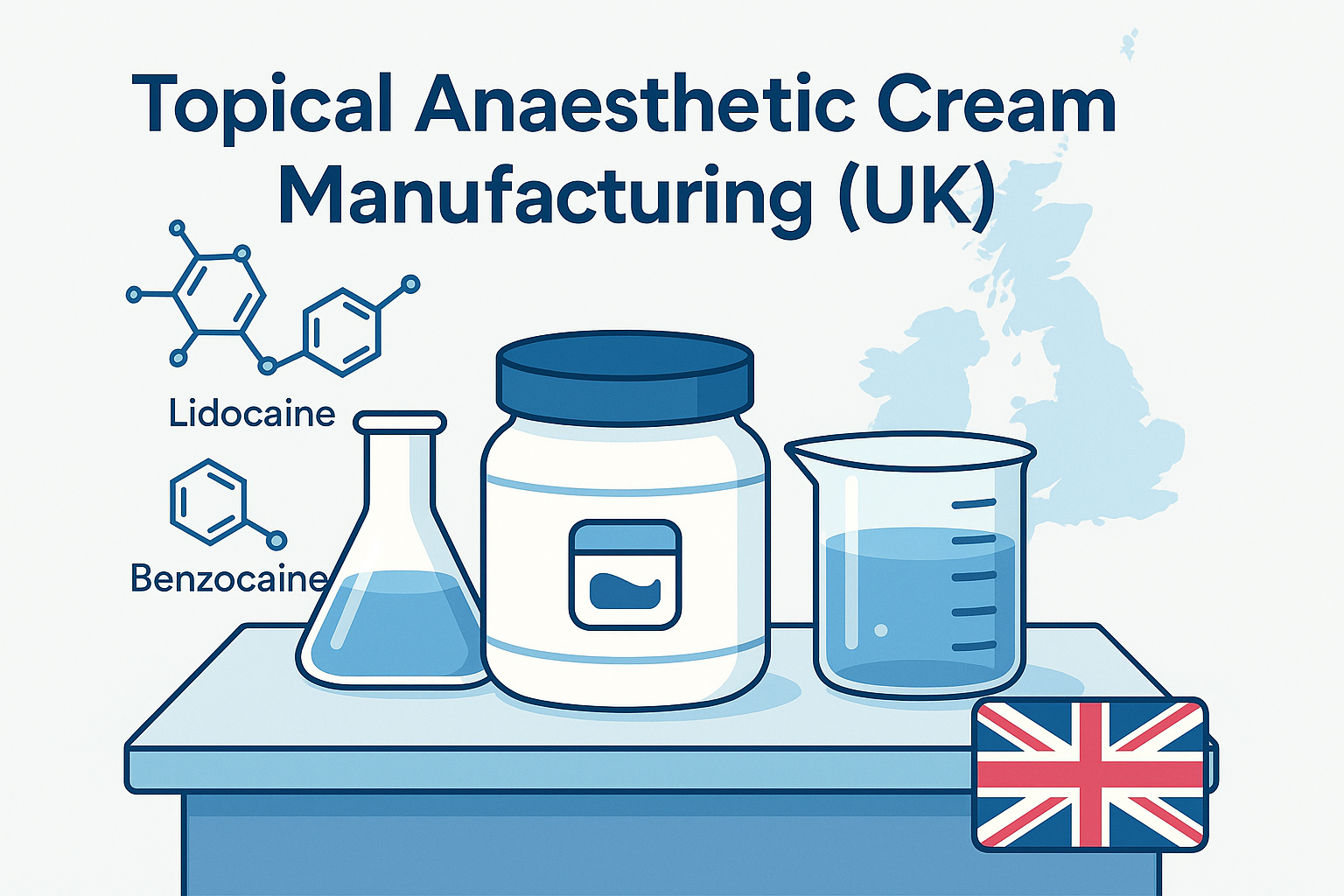
First, Lidocaine (CAS 137-58-6) is an amide local anaesthetic (C14H22N2O). It is widely used in topical R&D. For example, public IDs are listed at PubChem (CID 3676). Because these fields map well to LIMS and QC forms, records stay consistent.
Next, Benzocaine (CAS 94-09-7) is an ester local anaesthetic (ethyl 4-aminobenzoate; C9H11NO2). It is more water-repelling and only slightly soluble in water; therefore co-solvents and classic emulsifiers often help. See PubChem (CID 2337) and the ECHA benzocaine dossier (EC 202-303-5) for IDs and UK/EU classification.
Finally, UK mock labels read better when teams follow MHRA/GOV.UK best practice. As a result, review cycles are faster and audits are simpler.Table 1 — Lidocaine vs Benzocaine: quick R&D view (UK)
| Parameter | Lidocaine (CAS 137-58-6) | Benzocaine (CAS 94-09-7) | Why it matters |
|---|---|---|---|
| Chemical class | Amide | Ester | Esters can hydrolyse faster; amides may be steadier in water. |
| Identity (PubChem) | CID 3676 | CID 2337 | Stable IDs help avoid mix-ups and data drift. |
| Solubility (base) | Limited in water; salts increase solubility. | Low in water; prefers the oil/solvent side. | Co-solvents and emulsifiers shape performance. |
| ECHA identity | — | EC 202-303-5 | Align SDS and hazard text across suppliers. |
| Typical role | Fast, well-studied. | Surface-focused, water-repelling. | UK labs often screen both in prototypes. |
| UK doc tip | Apply MHRA label/pack best practice. | Keeps documents clear and audit-ready. | |
To illustrate, some public references use a eutectic mix to make processing easier. For example, EMLA cream at 2.5% lidocaine + 2.5% prilocaine turns into a liquid oil at room temperature. Therefore, it blends well into an O/W emulsion and supports steady release. See the official EMLA label (FDA).
In addition, the CristalChem eutectic lidocaine/prilocaine base helps model this behaviour for R&D only. As a result, teams can focus on IVRT/IVPT and simple steps.
Table 2 — Cream vs Gel vs Spray: levers for tattoo & aesthetics 🎨
| Dosage form | Structure | Main levers | Pros | Watch-outs |
|---|---|---|---|---|
| Cream (O/W) | Emulsion | Oil type, HLB, phase ratio, droplet size, thickness/flow | Familiar feel; a cover (film/wrap) can help onset | Check stability; prove wipe-off before inking |
| Gel (hydro/alcogel) | Polymer network | Polymer, neutraliser, alcohol %, water-holder | Clean look; often fast feel | Balance alcohol vs comfort; tune spreadability |
| Spray | Solution/suspension | Solvent mix, thickness for spraying, pump/propellant | Quick coverage; hygienic | Control flammability; keep film even; validate fill |
In practice, studios want predictable onset, sensible dwell time and clean removal. Therefore, add a wipe-off test and a simple residue check. Also, artists value even films, steady thickness and a neutral odour.
For context, public market writers point to steady growth and more formats. See Future Market Insights and Global Market Insights. However, cross-check numbers before budgeting.
For clean sourcing, start with lidocaine and benzocaine. In addition, apply safe storage rules to keep batches consistent.
To stay organised, use public guides. Follow MHRA/GOV.UK best practice for mock labels. Use FDA IVRT and the FDA draft IVPT for in-vitro work. Check the ECHA benzocaine dossier for identity/classification. Review the EMLA label for a public eutectic example.
Overall, writers note growth in numbing products across tattoo and aesthetic settings, plus cleaner residue and new formats. Because numbers vary by source, check more than one report.
Explore high-purity reagents and crystalline compounds at CristalChem.com – trusted supplier for laboratory and R&D applications. ✨
For laboratory and R&D use only. Not for human or veterinary use. This article is technical and educational; it is not medical, cosmetic or regulatory advice. Mentions of tattoo, piercing and aesthetic contexts are industry background only and are not usage recommendations. CristalChem products named here (for example lidocaine, benzocaine, eutectic base) are intended only for controlled laboratory or industrial research by trained professionals and are not finished goods, medicines, cosmetics or consumer products.
Please note: users are responsible for compliance and safe handling. Read and apply MHRA/GOV.UK best practice, FDA IVRT and FDA IVPT principles, and ECHA/REACH classification. Always read the SDS, wear suitable PPE, run risk assessments and follow SOPs. Availability may vary by country; restrictions may apply. Third-party names (e.g., “EMLA”) are for identification only.

Chemical Research Writer at CristalChem Academy. Passionate about chemistry, R&D, and turning laboratory insights into global wellness and industrial innovations.