
EUR


Focus keyphrase: caffeine in energy drinks SEO
Caffeine (Caffeine, CAS 58-08-2) is a key technological ingredient in energy drinks: it affects the declared dose, stability, taste, and on-pack communication. Below is a complete compendium—no health claims; only technology, process, and compliance.
Key regulatory & market context (EU/US) • Regulation (EU) 1169/2011 • UNESDA Code • Energy Drinks Europe • 21 CFR 182.1180 (eCFR)
Caffeine plays both a functional and a declarative role in energy drinks. First, it is a central component of the product’s functional profile. Second, it determines on-pack communication—especially in the EU, where drinks with more than 150 mg/L require a clear “high caffeine content” statement together with the amount per 100 mL (under Reg. (EU) 1169/2011). Therefore, already at the R&D brief stage it is worth planning the target caffeine level, the carrier, and the declaration method.
Industry primarily uses anhydrous caffeine, which is easy to dose and provides robust batch-to-batch consistency. It is widely available in FCC/Pharmacopeial grades, which simplifies audits and supplier qualification. Physicochemical references: PubChem (CID 2519), ChemSpider (ID 2424).
Typical EU category practice: around ~32 mg/100 mL (~320 mg/L) has become a de facto category norm. In practice, 20–32 mg/100 mL covers most products. Source: Energy Drinks Europe.
USA: historically, 21 CFR 182.1180 lists a limit of 0.02% (200 ppm) for cola-type beverages (GRAS). Energy drinks may be classified differently (beverage vs dietary supplement); consequently, teams design dose and label pathways according to the chosen category.
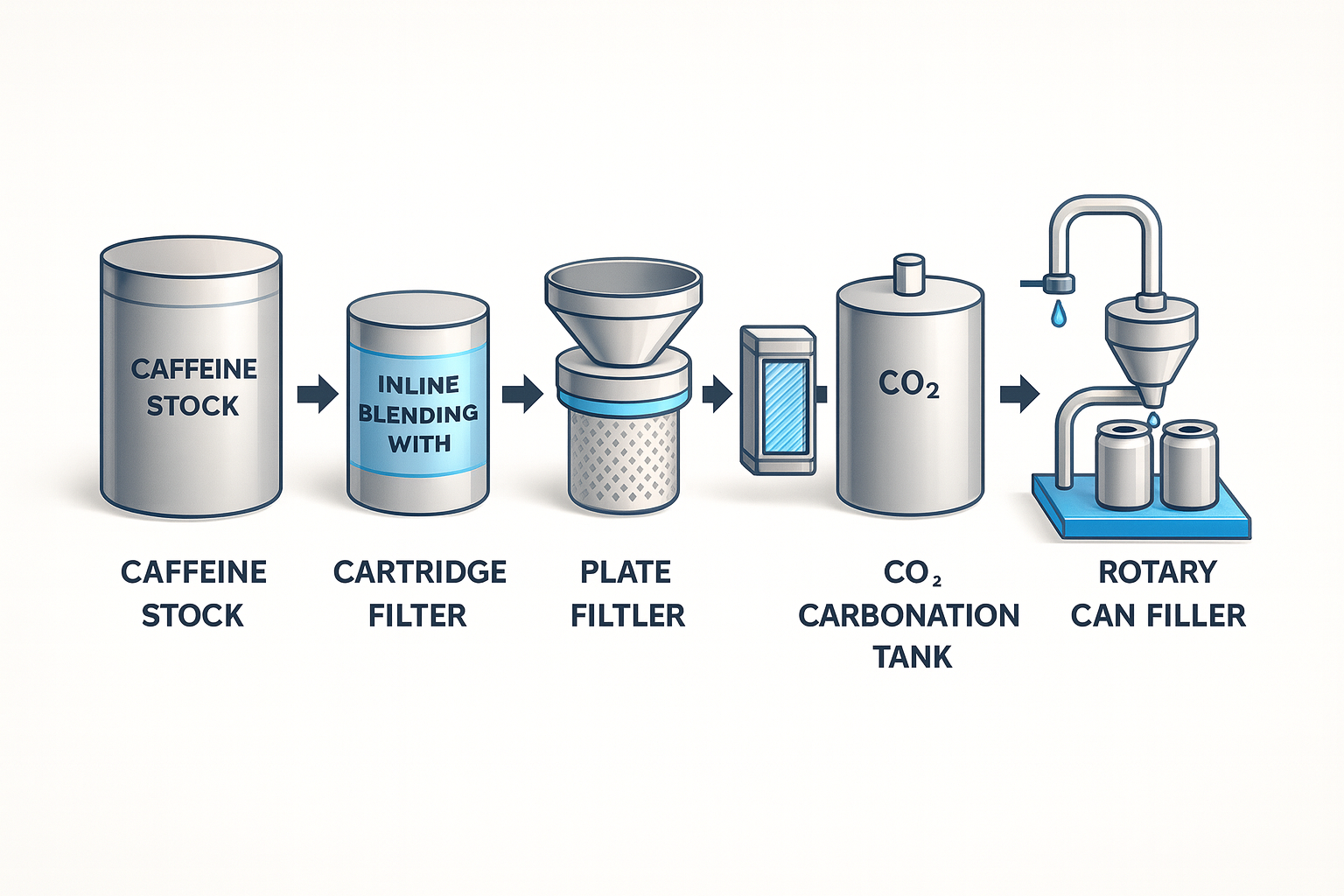
From a processing perspective, caffeine is readily soluble in warm water; at room temperature its solubility is approximately ~20 g/L (20 °C). Solubility increases with temperature, which facilitates preparation of a stock solution and precise metering in syrup rooms. Therefore, plants typically prepare a caffeine concentrate and add it while blending with sugar syrup or a sweetener solution. (See compiled data: ChemicalBook – solubility.)
pH impact: energy drinks are usually maintained at pH 2.8–3.6 (acids: citric, malic). In this environment caffeine is stable; however, light/UV and oxidative conditions can accelerate undesired transformations. Therefore, control dissolved oxygen, consider antioxidants, and use light-protective packaging. Reviews on aqueous degradation indicate that neutral/oxidative environments promote faster changes than acidic ones (see reviews on ScienceDirect).
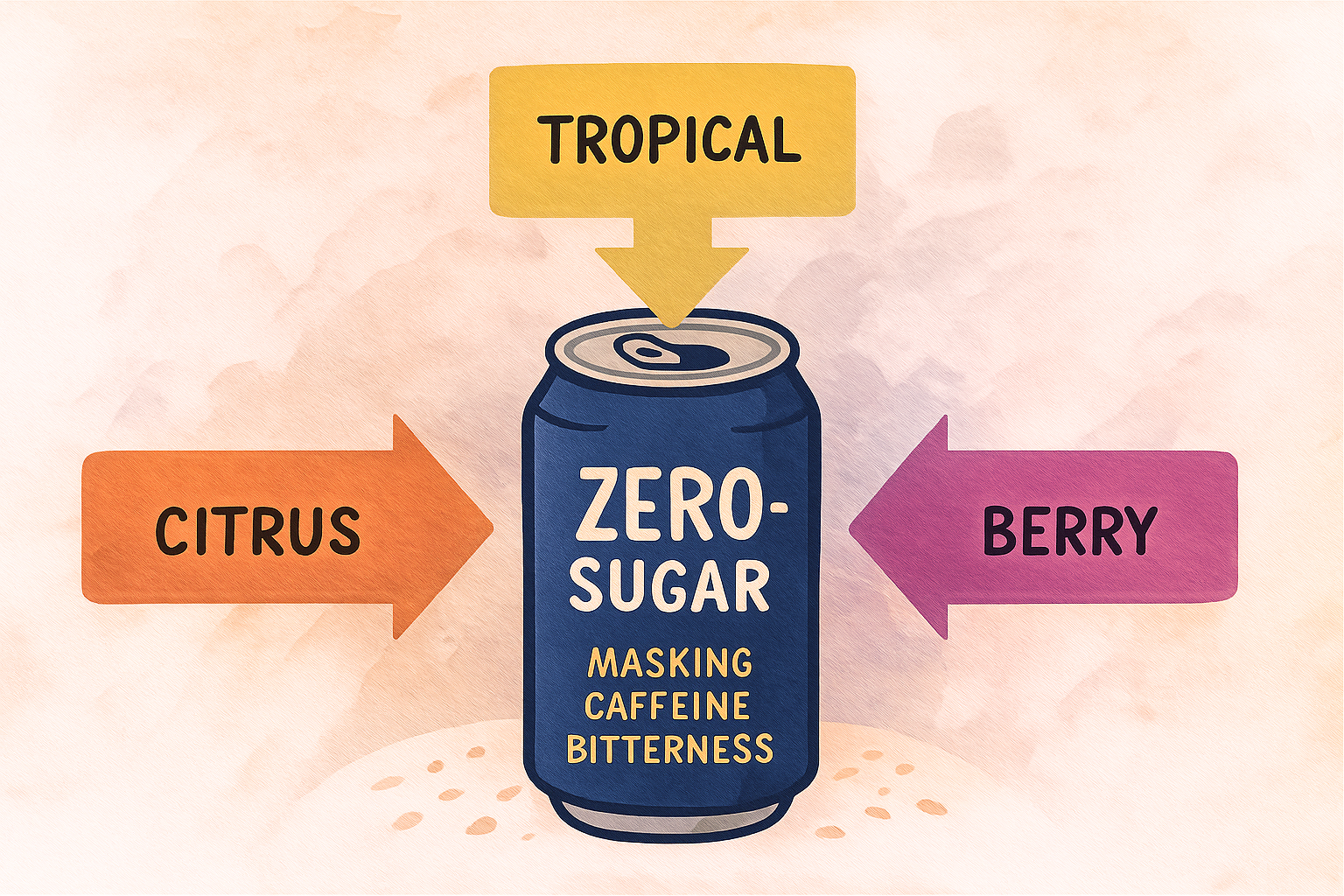
Energy drink formulas combine multiple components—caffeine, taurine, vitamins, acids, sweeteners (sucrose/glucose, sucralose, acesulfame K), flavours, and pH regulators. Taurine does not limit caffeine solubility at typical category levels; in practice, the larger risk is local supersaturation due to insufficient mixing. High-intensity sweeteners (e.g., sucralose + Ace-K) require careful balancing; caffeine contributes bitterness/astringency, thus taste modifiers and the right flavour directions (citrus, berry, tropical) keep the sensory profile acceptable. Water quality control (hardness and micro) remains a priority for clarity.
To reduce haze and precipitation risks:
Quick flow: Process water → Sweeteners/Syrup → Caffeine stock → Acids/pH regulators → Flavours → Filtration → Chilling → CO₂ → Filling → Stability & sensory.
EU: if a drink other than coffee/tea contains >150 mg/L caffeine, the label must display a “high caffeine content” statement and the exact amount per 100 mL (within the same field of vision as the name) — Reg. 1169/2011. Industry practice (e.g., UNESDA) aligns the category definition with this threshold; many EU products operate around ~320 mg/L.
USA: 21 CFR 182.1180 provides a historical reference of 0.02% (200 ppm) for cola-type beverages (GRAS); energy drinks may be labelled as beverages or supplements—this decision determines the panel and claims.
| Parameter | Value / Range | Why it matters | Source |
|---|---|---|---|
| Form | Anhydrous powder/crystalline | Easy and precise dosing | PubChem |
| Water solubility | ~20 g/L (20 °C), ↑ with T | Stock solution; fewer hotspots | ChemicalBook |
| Beverage pH | ~2.8–3.6 | Supports stability and clarity | ScienceDirect (reviews) |
| Typical EU dose | 20–32 mg/100 mL (~32 common) | Product positioning & taste | Energy Drinks Europe |
| EU label trigger | >150 mg/L | Mandatory statement + mg/100 mL | EU 1169/2011 |
| US reference | 0.02% (200 ppm) in “cola-type” | GRAS benchmark & GMP | 21 CFR 182.1180 |
Understanding purity grades (ACS/USP/BP) – a primerSafe storage of crystalline compoundsMenthol in R&D: the cooling chemistryTaurine technology in energy drinksCaffeine Anhydrous (CAS 58-08-2) – product
CTA: Explore high-purity reagents and crystalline compounds at CristalChem.com – trusted supplier for laboratory and R&D applications.
⚠️ Extended disclaimer (R&D & liability)
This article is provided for informational, educational and research (R&D) purposes only. CristalChem strives to keep data (including CAS, pH ranges, solubility, and regulatory references) accurate and current; however, the publication does not constitute technological, legal or compliance advice, nor a guarantee of fitness for any specific purpose. The user bears full responsibility for verifying specifications, ingredient limits, product classification (beverage vs supplement), label content and compliance with local law.
Before implementation, conduct your own QA/QC (including HPLC/UV), sensory and stability studies (e.g., 40 °C/4 weeks, 5–35 °C cycles), and a regulatory review for the target market. CristalChem accepts no liability for decisions or outcomes arising from use of this material.
For laboratory and R&D use only. Not for human or veterinary use.
Sources embedded in the text: PubChem, ChemSpider, EU 1169/2011, UNESDA Code, Energy Drinks Europe, 21 CFR 182.1180, ChemicalBook, ScienceDirect.

Chemical Research Writer at CristalChem Academy. Passionate about chemistry, R&D, and turning laboratory insights into global wellness and industrial innovations.