
USD


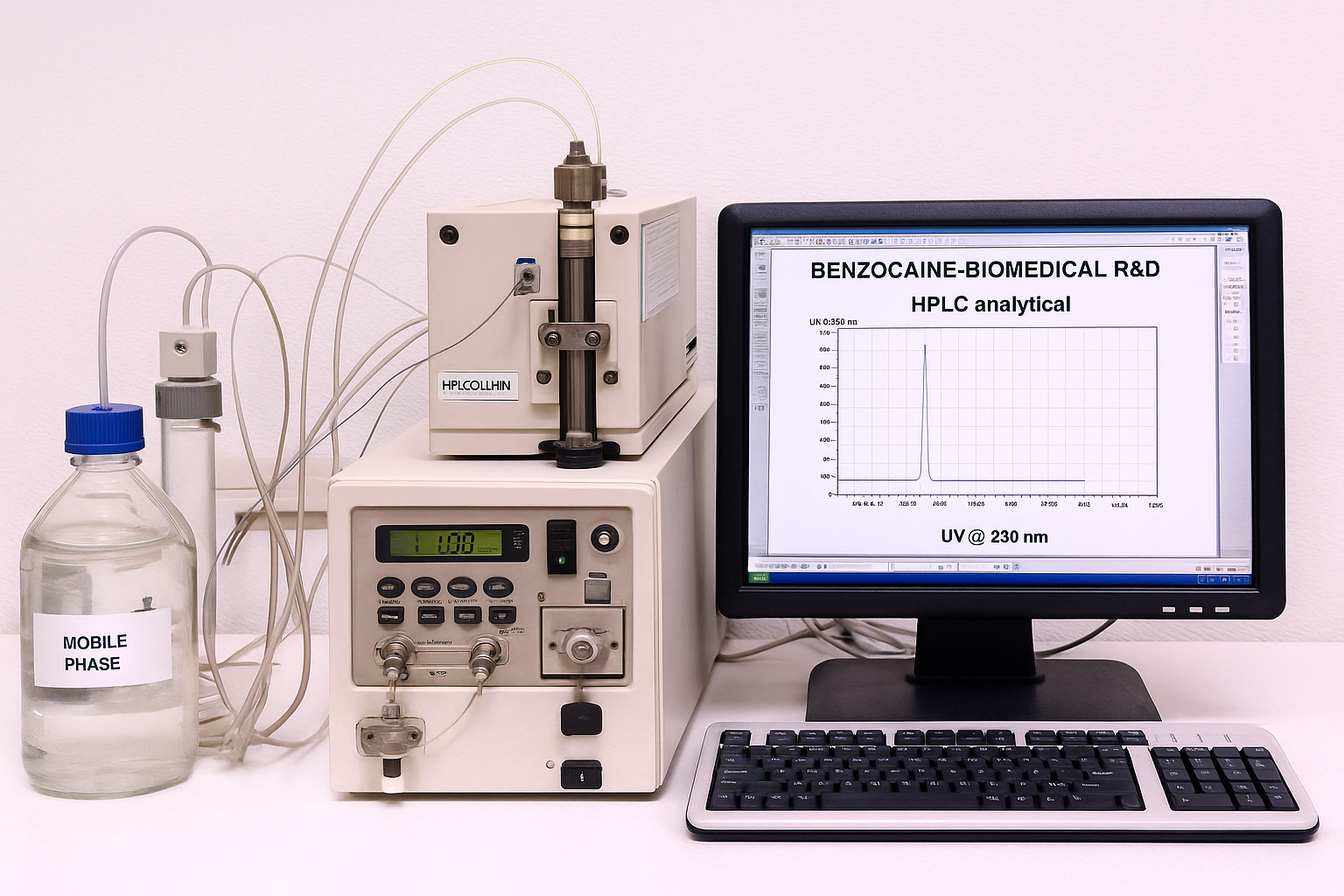
The topic benzocaine biomedical R&D describes how a pure and stable reagent (CAS 94-09-7) supports laboratory research. Scientists use it as an analytical standard and a diffusion model to study molecular transport. Therefore, it helps to compare results across laboratories. Moreover, it shows how classic organic compounds remain valuable in modern R&D environments. 🌍
Researchers apply benzocaine biomedical R&D as a benchmark in HPLC and UV-Vis analysis. It has a clear absorption peak at 283 nm, which allows easy calibration of detectors and verification of instrument performance. Consequently, teams can check linearity, retention time, and column stability more efficiently.
In addition, laboratories in the UK and Ireland use benzocaine to standardize chromatographic data. For comparison, you can explore related pages such as Benzocaine crystalline reagent, Lidocaine HCl crystalline powder, and How to read a Safety Data Sheet (SDS). These articles show how well-structured chemical data ensures reproducible analysis.
| Parameter | Value | Notes / Source |
|---|---|---|
| Chemical name (IUPAC) | Ethyl 4-aminobenzoate | Standard name in analytical catalogs |
| CAS | 94-09-7 | Unique substance identifier |
| Molar mass | 165.19 g/mol | PubChem record |
| Melting point | 89–90 °C | Consistent across literature sources |
| Solubility | Good in ethanol, ether, chloroform | Useful for preparation of reference standards |
| UV absorption | λmax ≈ 283 nm | Convenient for UV-Vis and HPLC-UV analysis |
| Purity (R&D grade) | ≥ 99.5% | High-purity research reagent (no API status) |
| External data | PubChem, ChemSpider, ECHA | PubChem · ChemSpider · ECHA |
When preparing calibration curves, scientists dissolve benzocaine in ethanol and perform serial dilutions. This simple workflow improves accuracy and repeatability. Therefore, it is a routine part of benzocaine biomedical R&D in analytical chemistry.
Scientists also study how benzocaine molecules move through membranes. For example, in Franz diffusion cells, they test the effects of solvents and temperature. As a result, they can map molecular permeability and understand how compounds behave in lipid systems. Moreover, such experiments teach students how to measure diffusion safely and precisely.
You can read more in Benzocaine vs Lidocaine vs Procaine, Menthol crystals, and Levamisole HCl. These related posts show how CristalChem integrates organic reagents into wider R&D workflows.
Benzocaine contains both an amino and an ester group. Therefore, it can form hydrogen bonds and dipole interactions with lipids and polymers. In addition, researchers examine how pH changes affect solubility and adsorption. Consequently, they gain better control over formulation and diffusion studies. However, these projects remain research-oriented and do not include clinical use.
Across Europe, benzocaine biomedical R&D follows strict research regulations. Laboratories in the UK, Ireland, Germany, and France use it in funded analytical projects. Moreover, its clean UV profile and predictable stability make it ideal for standardization. Finally, this helps maintain transparent data quality across international R&D networks.
Benzocaine biomedical R&D applies this molecule as a model compound and reference in chromatography, diffusion testing, and membrane-model studies.
Yes. CristalChem offers benzocaine with ≥99.5% purity as a research reagent comparable to pharmaceutical quality, yet without API status. It is designed for laboratory R&D only.
Yes, researchers use it safely in controlled laboratory environments to study diffusion and adsorption processes.
It provides a stable UV response (around 283 nm) and predictable retention time, which allows quick calibration and system checks.
The product is not approved for pharmaceutical or clinical applications. It is strictly for laboratory and R&D use.
Explore high-purity reagents and crystalline compounds at CristalChem.com – trusted supplier for laboratory and R&D applications. 🚀
Disclaimer: For laboratory and R&D use only. Not for human or veterinary use. This article is educational. CristalChem supplies research reagents of high purity (no API status).

Chemical Research Writer at CristalChem Academy. Passionate about chemistry, R&D, and turning laboratory insights into global wellness and industrial innovations.