
USD


Benzocaine (CAS 94-09-7) is the ethyl ester of p-aminobenzoic acid. It appears as a white crystalline powder, slightly sweet and non-hygroscopic.
On the other hand, Benzocaine Hydrochloride (CAS 23239-88-5) forms when Benzocaine reacts with hydrochloric acid. This reaction produces a water-soluble salt, which is more stable and easier to dissolve in analytical setups.
Both belong to the ester-type anaesthetic group, but their different forms lead to unique solubility and laboratory behaviour. Therefore, the difference between Benzocaine and Benzocaine HCl matters in every R&D application.
| Property | Benzocaine (Base) | Benzocaine HCl (Hydrochloride Salt) |
|---|---|---|
| CAS Number | 94-09-7 | 23239-88-5 |
| Molecular Formula | C9H11NO2 | C9H12ClNO2 |
| Molecular Weight | 165.19 g/mol | 201.65 g/mol |
| Form | White crystalline powder | Fine hygroscopic powder |
| Solubility | Insoluble in water, soluble in ethanol | Freely soluble in water and ethanol |
| Melting Point | 88–90 °C | 60–63 °C |
| pH (1% solution) | ~6.5 | ~4.5–5.5 |
| Purity (R&D) | ≥ 99.0% | ≥ 99.5% |
| Stability | Moderate, sensitive to hydrolysis | Higher, stable in acidic form |
🧪 Interpretation:
Therefore, Benzocaine base suits non-aqueous reactions, while Benzocaine HCl works better in aqueous analytical systems where solubility and pH control are vital.
The difference between Benzocaine and Benzocaine HCl is most visible in solubility.
Benzocaine base dissolves in organic solvents such as ethanol or acetone.
However, Benzocaine HCl dissolves quickly in water and ethanol, which makes it ideal for aqueous calibration and reference studies.
In addition, the hydrochloride form remains chemically stable during long-term storage. Therefore, laboratories often prefer Benzocaine HCl for spectrophotometric or pH-controlled experiments.
At CristalChem, both Benzocaine forms meet strict R&D-grade standards.
Benzocaine HCl typically shows better reproducibility in analytical tests, since its ionic structure allows even dissolution.
Meanwhile, Benzocaine base remains a valuable compound for solvent interaction studies and ester reactivity testing.
For further explanation, see Understanding purity grades in research reagents.
Chemically, both forms share the p-aminobenzoate backbone, but the HCl version includes an added chloride ion, which changes its polarity.
As a result, Benzocaine HCl behaves differently under varying pH and solvent conditions.
Similar patterns can be seen in other crystalline reagents, such as Procaine HCl (CAS 51-05-8) and Lidocaine vs Lidocaine HCl.
For related studies, visit:
Proper storage extends the shelf life of both compounds.
Store at 15–25 °C, away from moisture and sunlight.
Moreover, Benzocaine HCl should be kept in sealed glass containers due to its hygroscopic nature.
For more guidance, see Safe storage and handling of crystalline reagents.
Both Benzocaine and Benzocaine HCl are valuable in R&D environments.
They are used as reference reagents, analytical standards, and model compounds for ester reactions.
For example, researchers apply them in:
However, all CristalChem reagents are supplied strictly for laboratory and R&D use only, never for medical or cosmetic applications.
| Aspect | Benzocaine | Benzocaine HCl |
|---|---|---|
| Solubility | Organic solvents | Water and ethanol |
| Stability | Moderate | High |
| Analytical Use | Solvent studies | Aqueous systems |
| pH | ~6.5 | ~5 |
| Purity | ≥ 99.0% | ≥ 99.5% |
| Application | Organic R&D | Analytical and calibration |
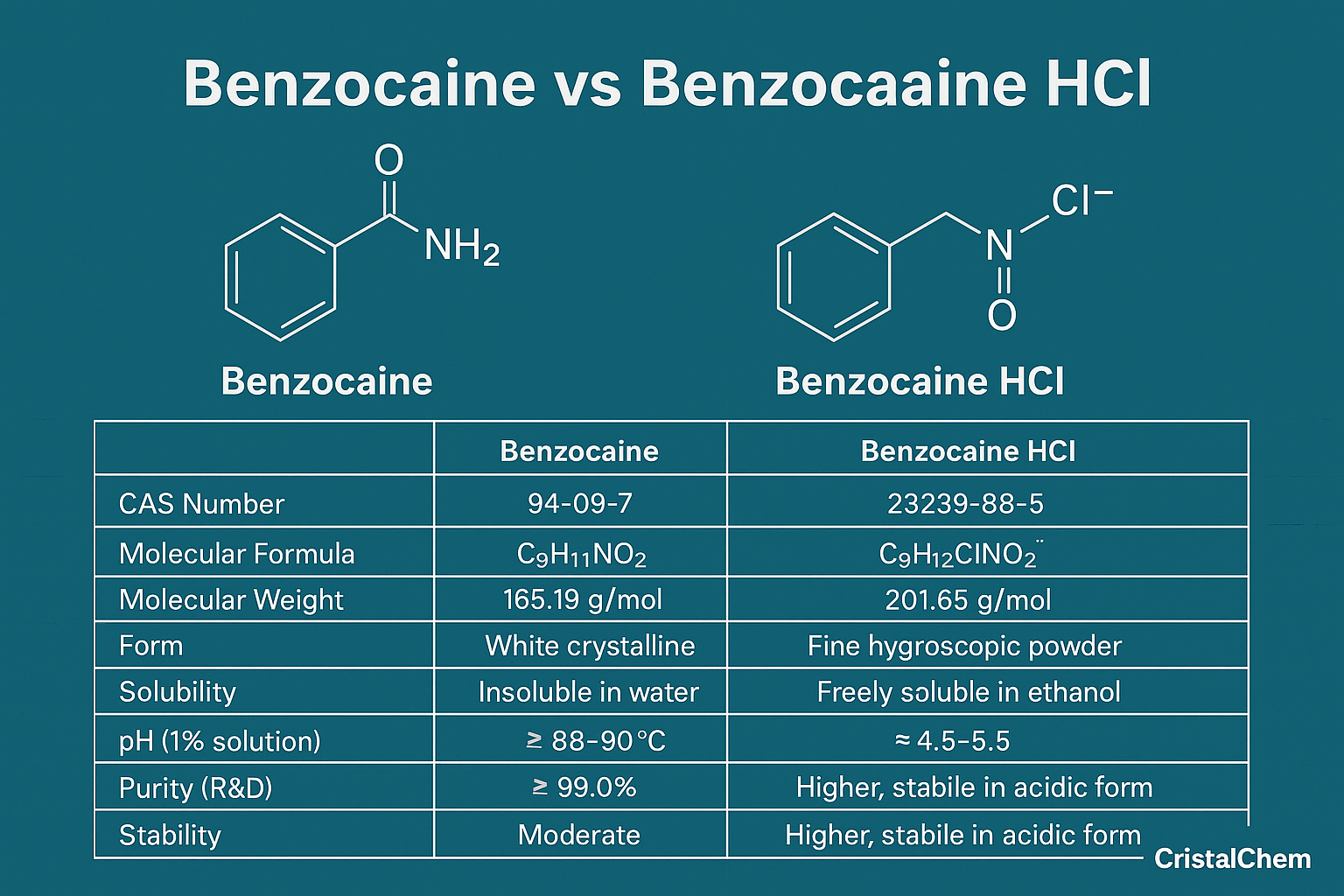
In summary, Benzocaine HCl provides better solubility and stability, while Benzocaine base remains useful for solvent and organic research. Consequently, knowing when to use each form enhances reproducibility and precision in R&D.
For extended learning, you can also explore:
1. What is the main difference between Benzocaine and Benzocaine HCl?
Benzocaine is a neutral ester compound, while Benzocaine HCl is its hydrochloride salt with higher water solubility and stability.
2. Why is Benzocaine HCl more popular in analytical use?
Because it dissolves easily in water and produces consistent results in quantitative testing.
3. Can Benzocaine base dissolve in water?
Not efficiently. It requires organic solvents such as ethanol or ether.
4. What are their CAS numbers?
Benzocaine – 94-09-7; Benzocaine HCl – 23239-88-5.
5. How should Benzocaine HCl be stored?
Keep it in airtight glass containers at 15–25 °C, away from humidity.
6. Are these reagents suitable for pharmaceuticals?
No. They are supplied for laboratory and R&D use only.
🔬 In conclusion, understanding the difference between Benzocaine and Benzocaine HCl helps laboratories make the right choice for analytical or organic applications.
Moreover, their contrasting solubility and stability properties define their unique strengths.
👉 Explore high-purity Benzocaine and Benzocaine HCl reagents at CristalChem.com – your reliable partner in research and analytical chemistry.
⚠️ All information provided in this article is intended solely for scientific, educational and research purposes! The data, specifications and analytical notes are based on available laboratory literature and internal R&D testing. CristalChem does not guarantee completeness or absolute accuracy of the information presented — users should independently verify all details before use in their own research environment. All reagents mentioned are strictly for laboratory and R&D applications only. Not for human or veterinary use!

Chemical Research Writer at CristalChem Academy. Passionate about chemistry, R&D, and turning laboratory insights into global wellness and industrial innovations.