GBP


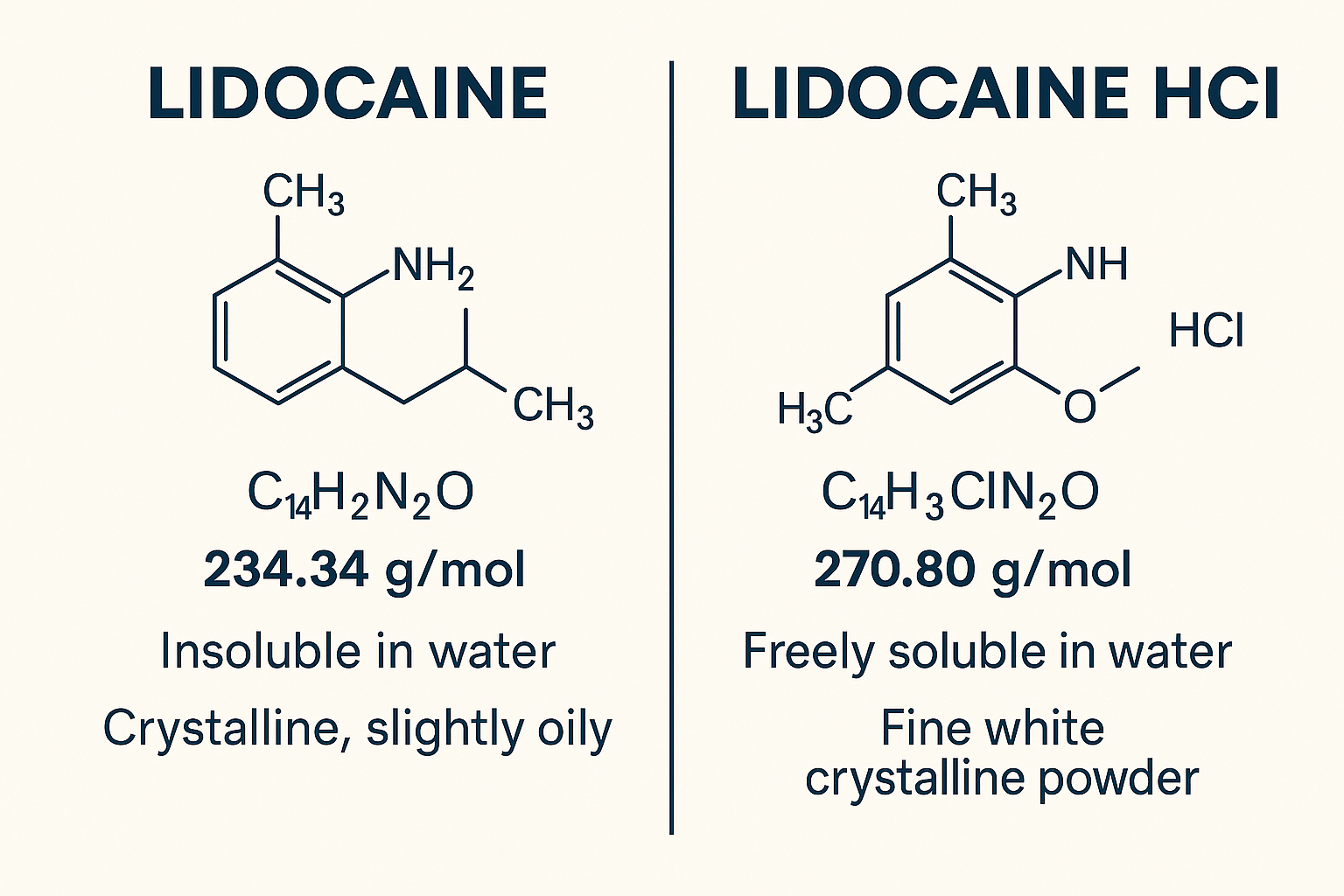
Lidocaine, known chemically as 2-(diethylamino)-N-(2,6-dimethylphenyl)acetamide, is a base form with the CAS number 137-58-6.
Its hydrochloride salt, Lidocaine HCl (CAS 73-78-9), is the acid-stabilised version, formed by combining lidocaine base with hydrochloric acid to increase stability and solubility.
The distinction between these two forms is crucial: while they share the same molecular core, their ionic states and behaviour in solvents differ significantly, affecting how they perform in analytical, synthesis or formulation environments.
| Property | Lidocaine (Base) | Lidocaine HCl (Hydrochloride Salt) |
|---|---|---|
| CAS Number | 137-58-6 | 73-78-9 |
| Molecular Formula | C14H22N2O | C14H23ClN2O |
| Molecular Weight | 234.34 g/mol | 270.80 g/mol |
| Form | Crystalline powder, slightly oily | Crystalline, fine white powder |
| Solubility | Practically insoluble in water, soluble in organic solvents | Freely soluble in water and ethanol |
| Melting Point | 68–69 °C | 77–79 °C |
| pH (1% solution) | ~8 (basic) | ~5–6 (acidic to neutral) |
| Purity Grades (R&D) | ≥ 99.0% | ≥ 99.5% |
| Stability | Sensitive to oxidation | Enhanced stability due to hydrochloride salt |
🧪 Interpretation:
Therefore, Lidocaine base is primarily used when non-aqueous reactions or solvent extractions are needed, while Lidocaine HCl is preferred for aqueous analytical methods and formulation studies.
One of the major differences lies in solubility profiles. Lidocaine base dissolves efficiently in organic solvents like chloroform, acetone and ether, which makes it valuable for non-polar analytical setups and compound synthesis.
In contrast, Lidocaine HCl demonstrates high water solubility, making it ideal for solution testing, titrations, and reference standards in laboratory settings.
Moreover, Lidocaine HCl exhibits better storage stability, resisting oxidation and degradation under ambient conditions — a property particularly useful for long-term R&D studies.
CristalChem supplies both forms of Lidocaine with high purity grades suitable for R&D and analytical chemistry.
The hydrochloride salt version typically achieves higher reproducibility in spectroscopic and chromatographic methods because of its ionic uniformity and easier dissolution.
On the other hand, Lidocaine base allows researchers to explore lipophilic interactions, solvent effects, and partition coefficients — making it indispensable for comparative chemical modelling and compound stability studies.
Lidocaine belongs to the amide class of local anaesthetics, similar to Benzocaine and Procaine derivatives.
While Benzocaine crystalline reagent (CAS 94-09-7) is an ester-based structure, Lidocaine and Procaine HCl (CAS 51-05-8) are both amide derivatives — however, Lidocaine shows greater chemical stability in basic media.
👉 Learn more about Benzocaine crystalline reagent and Procaine HCl crystalline form in our previous CristalChem insights.
These internal comparisons help researchers choose the right anaesthetic reagent for analytical or synthetic protocols depending on solvent compatibility and ionisation characteristics.
Proper storage ensures the long-term stability of both Lidocaine and Lidocaine HCl.
According to CristalChem’s quality standards and international guidelines:
For more best-practice advice, see our detailed guide on safe storage and handling of crystalline reagents.
Both Lidocaine and Lidocaine HCl are primarily studied as reference and analytical compounds.
Their roles in R&D include:
Importantly, CristalChem reagents are supplied exclusively for research and development purposes — not for medical or veterinary use.
As explained in our related article Understanding purity grades in research reagents, analytical precision depends heavily on reagent purity.
Lidocaine reagents from CristalChem are tested according to ACS and R&D purity standards, ensuring consistent melting points, solubility and pH performance across batches.
In summary, Lidocaine HCl is the water-soluble, stable salt form suited for aqueous and analytical conditions, whereas Lidocaine base offers lipophilic versatility for non-polar and synthetic work.
Understanding these distinctions allows laboratories to make informed decisions in both research and development.
For extended learning, you can also explore:
1. What is the main chemical difference between Lidocaine and Lidocaine HCl?
Lidocaine is a neutral amide base, while Lidocaine HCl is its hydrochloride salt. The salt form contains an additional chloride ion that increases solubility in water.
2. Why do laboratories often prefer Lidocaine HCl?
Because of its enhanced water solubility, chemical stability, and reproducibility in quantitative analysis.
3. Can Lidocaine base be dissolved in water?
Not effectively. It is only slightly soluble in water but dissolves well in organic solvents.
4. What are the CAS numbers of each compound?
Lidocaine: 137-58-6.
Lidocaine HCl: 73-78-9.
5. Are these reagents suitable for pharmaceutical use?
No. CristalChem supplies both compounds strictly for laboratory and R&D purposes only.
6. How should Lidocaine HCl be stored?
In a cool, dry place, away from direct light, preferably in sealed glass containers with controlled humidity.
🔬 In conclusion, while both forms share a similar molecular structure, their ionic composition, solubility, and stabilitymake them functionally distinct in R&D workflows.
Lidocaine HCl is the preferred choice for aqueous analytical operations, while the base form offers flexibility for solvent-based reactions.
👉 Explore high-purity crystalline reagents, including Lidocaine and Lidocaine HCl, at CristalChem.com – your trusted supplier for laboratory and R&D applications.
⚠️For laboratory and R&D use only. Not for human or veterinary use. All information provided in this article is intended solely for scientific, educational and research purposes. The data, specifications and analytical notes are based on available laboratory literature and internal R&D testing. CristalChem does not guarantee completeness or absolute accuracy of the information presented — users should independently verify all details before use in their own research environment. All reagents mentioned are strictly for laboratory and R&D applications only. Not for human or veterinary use.

Chemical Research Writer at CristalChem Academy. Passionate about chemistry, R&D, and turning laboratory insights into global wellness and industrial innovations.