
USD


CAS: 94-09-7 • EC: 202-303-5
🟩 Buy HPLC-Verified Benzocaine — safe worldwide delivery
When a shipment of benzocaine powder arrives, buyers must decide quickly whether it is authentic and pure. Therefore, this guide shows, step by step, how to verify quality using COA & SDS checks, a fast melting point test, and a simple review of the HPLC report. Moreover, it explains common red flags from unverified brokers and, consequently, helps you avoid delays, rejections, and hidden costs.
For reference data, you can consult PubChem and, additionally, the NIST WebBook. As a result, QC teams can cross-check identity and expected physical properties before release.
Benzocaine is used in cosmetic creams, dental gels, and tattoo products; consequently, off-spec batches may trigger complaints, recalls, or regulatory action. In practice, purity below 99% often correlates with broader melting ranges and, furthermore, unstable performance in formulations. Therefore, CristalChem supplies benzocaine with ≥99.5% HPLC and complete documentation to protect your brand.
| Parameter | Accept | Why |
|---|---|---|
| Assay (HPLC) | ≥ 99.5 % | Therefore, potency and stability remain consistent. |
| Melting range | 88–90 °C | Consequently, synthesis route is correct. |
| Loss on drying | ≤ 0.30 % | As a result, storage is safer. |
| Residue on ignition | ≤ 0.10 % | Hence, process is clean. |
| Heavy metals | < 10 ppm | Additionally, it supports audits. |
Moreover, the COA should carry a lot number, a QA signature, and a recent date. If any of these are missing, request a corrected document immediately; otherwise, you risk customs questions later.
Verify that all 16 sections are present. In particular, confirm Section 3 lists “Ethyl 4-aminobenzoate, CAS 94-09-7,” and, additionally, check Section 14 shows “Not classified as hazardous for transport.” Finally, ensure the revision date is current. For regulatory context, see the ECHA substance page.
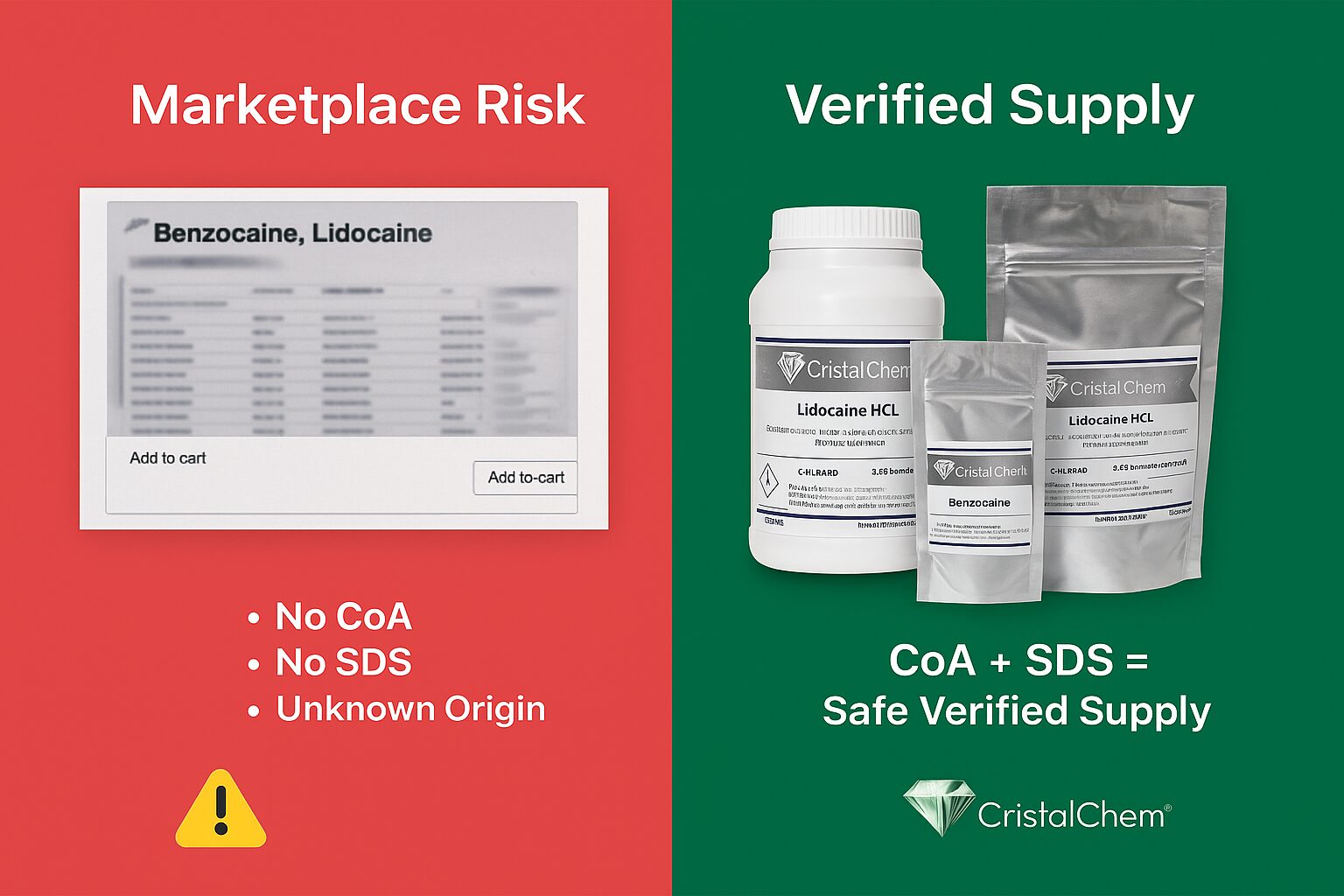
🟩 Request COA & SDS — fast response, safe delivery
A melting point test is fast and, importantly, very telling. Therefore, place ~50 mg in a capillary tube, heat at ~1 °C/min from 85 °C, and then observe the start and end of melting. Accept a narrow range of 88–90 °C; broader or lower values usually indicate impurities.
Tip: if the powder shows a yellow tint or melts across 85–92 °C, reject the lot. Consequently, you will avoid failed batches and reformulation costs.
Meanwhile, keep the capillary and instrument IDs in your records; as a result, audits become simpler later.
🟩 How to read SDS/COA — CristalChem Academy
Next, open the HPLC chromatogram. Typically, benzocaine appears as one main peak with ≥99.5% area; therefore, side peaks should remain ≤0.2% each. Moreover, the report should include column type (C18), mobile phase (e.g., MeOH/H2O), wavelength (~285 nm), and retention time (~5 min).
If the COA lacks a chromatogram, ask for it immediately; otherwise, treat the batch as unverified. For identity background, compare with PubChem and, additionally, NIST WebBook references.
🟩 Get HPLC-verified lots — safe worldwide delivery
Visual: powder must be bright white and uniform; otherwise, oxidation or poor crystallization is likely.
Odor: the product should be neutral; strong chemical smell suggests residual solvents.
COA: missing signature or mismatched lot number; consequently, traceability fails.
SDS: sections copied from other chemicals; therefore, details conflict.
Furthermore, beware of sellers who refuse factory audits or ship as “cosmetics” to bypass checks. In practice, these shortcuts cause detentions and, finally, destruction orders at the border.
| Parameter | CristalChem | Unverified broker |
|---|---|---|
| Purity (HPLC) | 99.7–99.9 % | 97–99 % (claimed 99.9 %) |
| Melting range | 88.5–89.0 °C | 85–92 °C |
| COA | Signed + lot match | No signature / mismatch |
| Compliance | REACH/CLP ready | Unknown / missing |
| Shipping | DDP/DAP/CIF insured | FOB only, no insurance |
🟩 Read next: Benzocaine vs Lidocaine — uses & QC tips
If any element is missing, hold the batch; otherwise, you may face returns or fines. Meanwhile, CristalChem pre-verifies all data so that clearance proceeds on the first attempt.
🟩 Order REACH/CLP-compliant Benzocaine — safe delivery
If you still have doubts, commission a third-party HPLC test in the UK, Germany, or Canada. Typically, results arrive within three days; consequently, you gain independent assurance for your records. Additionally, CristalChem keeps retained samples for 12 months, so parallel testing remains possible on request.
For methodological overviews, see ScienceDirect. Furthermore, archive reports alongside batch documents for future audits.
A UK buyer purchased a 5 kg lot from a broker at an attractive price. However, the melting range spanned 85–92 °C and, consequently, the HPLC showed extra peaks. Therefore, the team rejected the batch and, meanwhile, sourced from CristalChem. Finally, compliant material arrived DDP within six days, and the launch remained on schedule.
| Check | Accept | Reject |
|---|---|---|
| HPLC purity | ≥ 99.5 % | < 99.0 % |
| Melting point | 88–90 °C | < 87 °C or > 91 °C |
| SDS sections | All 16 present | Missing or outdated |
Apply these rules consistently; consequently, your rejection rate drops and, moreover, your brand remains protected.
To conclude, combine a thorough document check with a quick melting point test and, finally, a clear HPLC review. Consequently, you will filter out counterfeits, prevent delays, and protect your end users. Meanwhile, CristalChem provides traceable, independently tested benzocaine with safe worldwide delivery — so your projects start on time.
🟩 Get HPLC-verified Benzocaine — safe worldwide delivery
Title: “Benzocaine Purity Verification — 3-Step Importer Checklist” — panel 1: HPLC 99.5% peak; panel 2: thermometer 88–90 °C; panel 3: SDS with CAS 94-09-7 and CristalChem logo. ALT: Benzocaine purity verification checklist — CristalChem.
Embedded internal links: benzocaine product, benzocaine vs lidocaine, procaine, phenacetin, paracetamol, SDS guide. External sources: PubChem, NIST, ECHA, ScienceDirect, Verified Market Reports, FDA.
⚠️Disclaimer: All information provided in this article is intended solely for scientific, educational and research purposes! The data, specifications and analytical notes are based on available laboratory literature and internal R&D testing. CristalChem does not guarantee completeness or absolute accuracy of the information presented — users should independently verify all details before use in their own research environment. All reagents mentioned are strictly for laboratory and R&D applications only. Not for human or veterinary use!

Chemical Research Writer at CristalChem Academy. Passionate about chemistry, R&D, and turning laboratory insights into global wellness and industrial innovations.