USD

A practical, compliant, and risk-aware guide for sourcing Lidocaine Hydrochloride (CAS 6108-05-0) across the UK, EU, USA, Canada, and Australia — with a strong focus on REACH/CLP/FDA rules, supplier credibility, and safe worldwide delivery. ✅
Lidocaine Hydrochloride (Lidocaine HCl) is a trusted local anesthetic for topical products, dental gels, and R&D work. It dissolves well, acts fast, and blends easily into common base systems. As a result, labs and manufacturers rely on it for consistent performance.
Moreover, demand remains strong across Europe and North America. Meanwhile, many OEM brands scale up production and need stable, fully documented supply. Therefore, buyers must look beyond headline offers and check compliance early. In practice, choosing a verified supplier saves time, avoids customs delays, and protects your projects.
For a broader view of local anesthetics, explore our related pieces on Benzocaine, Procaine HCl, and Menthol. Together, these guides form our Local Anesthetics Hub 📚.
To begin with, here is a compact overview you can use during supplier vetting. As always, match these fields against the COA.
| Property | Specification | Reference |
|---|---|---|
| CAS | 6108-05-0 | PubChem |
| EC Number | 200-803-8 | ECHA Substance Info |
| Pharmacopoeia | USP / Ph. Eur. / BP | Pharmacopoeia standards |
| Appearance | White crystalline powder | COA |
| Solubility | Freely soluble in water & ethanol | USP tests |
| Typical mesh | 60–200 mesh (OEM-friendly) | Supplier spec |
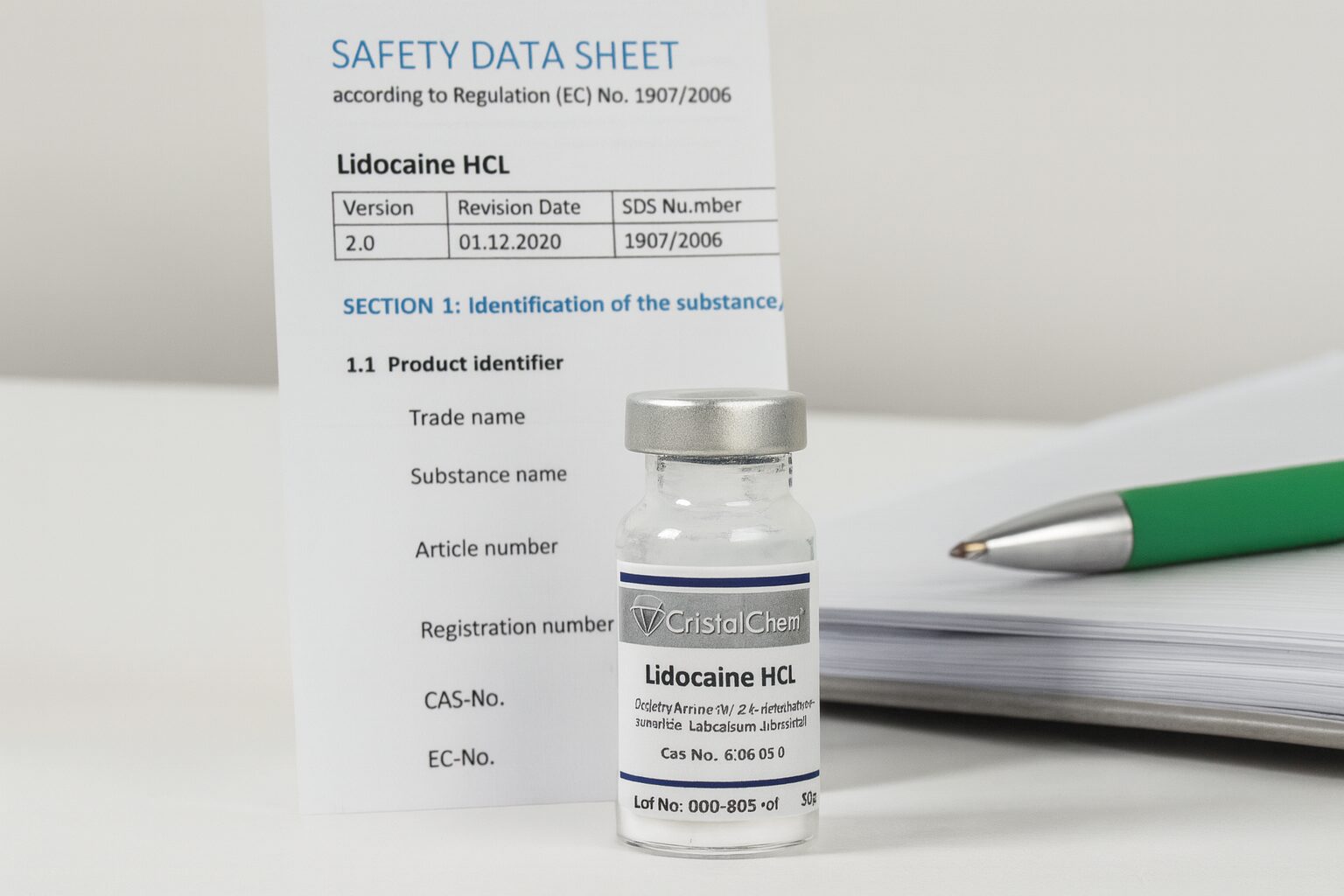
| Docs | COA, SDS, REACH letter | CristalChem SDS Library |
Consequently, any batch should ship with a clean COA and a recent SDS. In addition, ask for a batch-specific HPLC chromatogram when your use case is sensitive.
Because Lidocaine HCl sits at the intersection of pharma and cosmetics, compliance truly matters. Therefore, align your sourcing with the following frameworks:
Firstly, the EU requires valid REACH registration for tonnage bands and CLP-compliant labeling. Otherwise, customs can hold your shipment. As a result, request the supplier’s REACH evidence early. See ECHA — REACH registration and Understanding CLP.
Secondly, after Brexit the UK treats API imports under MHRA rules. Consequently, shipments labeled only as “cosmetic raw material” may be flagged if the actual use is pharmaceutical. Therefore, use MHRA-aligned documentation to avoid delays.
Thirdly, topical uses of Lidocaine fall under 21 CFR Part 348. Even so, API imports still need FDA establishment registration. In other words, “OTC monograph” does not remove the need for clear, auditable paperwork.
Similarly, Health Canada (NNHPD) and Australia’s TGA allow lab or industrial import with proper documents. However, finished dosage forms require registration and stricter review.
To summarize, if you validate REACH/CLP (EU), MHRA (UK), and FDA (US) in advance, your shipments move faster and safer.
Overall, demand is steady across pharma and OEM cosmetics. At the same time, authorities now check paperwork more closely. Because of this, buyers should verify dossiers, labels, and audits before issuing a PO.
For context, consult independent overviews like Verified Market Reports, Grand View Research, and Statista. Nevertheless, treat public figures as directional, not as a direct quote for your project budget.
To be clear, China has capable API plants. However, the broker layer is uneven. As a result, many offers come without full REACH dossiers, with missing COA traceability, or with non-standard labeling. In addition, some lots reuse generic COAs that do not match real batches. Consequently, customs may hold or even reject shipments.
Therefore, audit the source, not only the quote. Most importantly, ask for real batch IDs and a recent SDS. Additionally, cross-check with ICH Q3C and WHO GMP.
Start here if you import to the UK. Because MHRA audits paperwork, align your files with pharma language. In addition, match your HS code 29224985 and describe the intended use precisely.
✅ Request CristalChem’s MHRA-compliant batch documents
Likewise, the EU requires REACH/CLP alignment. Therefore, obtain the REACH letter early and verify labels. Also, prepare SDS in the latest EU format.
✅ Order EU-grade Lidocaine HCl (REACH pre-registered)
In the US, topical products fall under FDA 21 CFR 348. However, your facility still needs FDA establishment registration for raw material import.
✅ Request FDA OTC dossier (21 CFR 348)
In Canada, NNHPD allows lab or industrial use with normal paperwork. Even so, finished dosage forms need registration. Hence, plan your documentation path from day one.
✅ Receive Canadian-format SDS & COA
For Australia, TGA rules apply. Because solutions above certain thresholds are prescription-only, ensure your import is clearly marked as lab or industrial grade.
✅ Request TGA-safe Lidocaine HCl
To keep it simple, use this checklist for every shipment:
Additionally, consider DDP when you want a hands-off import. Alternatively, use CIF when your internal broker handles the last mile. Either way, CristalChem supports both paths with the same documentation quality.
Need templates? Visit our SDS Library and Import Checklists 🗂️.
Instead of chasing short-term quotes, plan budgets around stable drivers. In brief, these factors move the needle the most:
As a consequence, “too-cheap” quotes often ignore real compliance costs. Therefore, the final landed cost can be higher due to re-testing, delays, or rejections. By contrast, CristalChem quotes include the documentation effort and the risk control up front.
Generally, Lidocaine HCl is safe when used correctly. Nevertheless, wear gloves, avoid dust, and store it dry. For more detail, review toxicology notes and compare with Benzocaine on PubChem. Finally, follow your local pharmacopoeia for tests and acceptance criteria.
Often, teams source Lidocaine along with complementary materials. Accordingly, check our primers on Benzocaine, Procaine HCl, Phenacetin, Menthol, and Caffeine. Together, they form a practical toolkit for cosmetic and OTC projects.
Above all, we keep your supply lawful and reliable. Because compliance is part of our core process, our clients spend less time on rework and more time on launch.
🚀 Contact CristalChem for verified Lidocaine HCl (worldwide)
Looking ahead, enforcement will tighten across major markets. Therefore, transparent documentation will decide who ships smoothly and who does not. In short, pick suppliers with clean paperwork and stable QA. Consequently, your R&D and launches will run on time.
Learn more in our Local Anesthetics Hub and Import Checklists. As always, our team is here to help. 🤝
As explained in our Lidocaine HCl identity & specs article, documentation quality (COA + SDS) defines sourcing integrity.
For buyers comparing landed options, see the DDP price-by-pack-size guide.

Chemical Research Writer at CristalChem Academy. Passionate about chemistry, R&D, and turning laboratory insights into global wellness and industrial innovations.