
USD


Benzocaine and Lidocaine remain two of the most frequently used anaesthetic reagents in laboratory R&D, pharmaceutical formulation testing, and chemical synthesis. Yet, in 2026, researchers face a new challenge — balancing purity, compliance, cost, and logistics under modern REACH and CLP frameworks. This CristalChem Academy guide explains which reagent suits your lab needs best, how pricing differs by region, and why DDP delivery 🌍 makes a big difference.
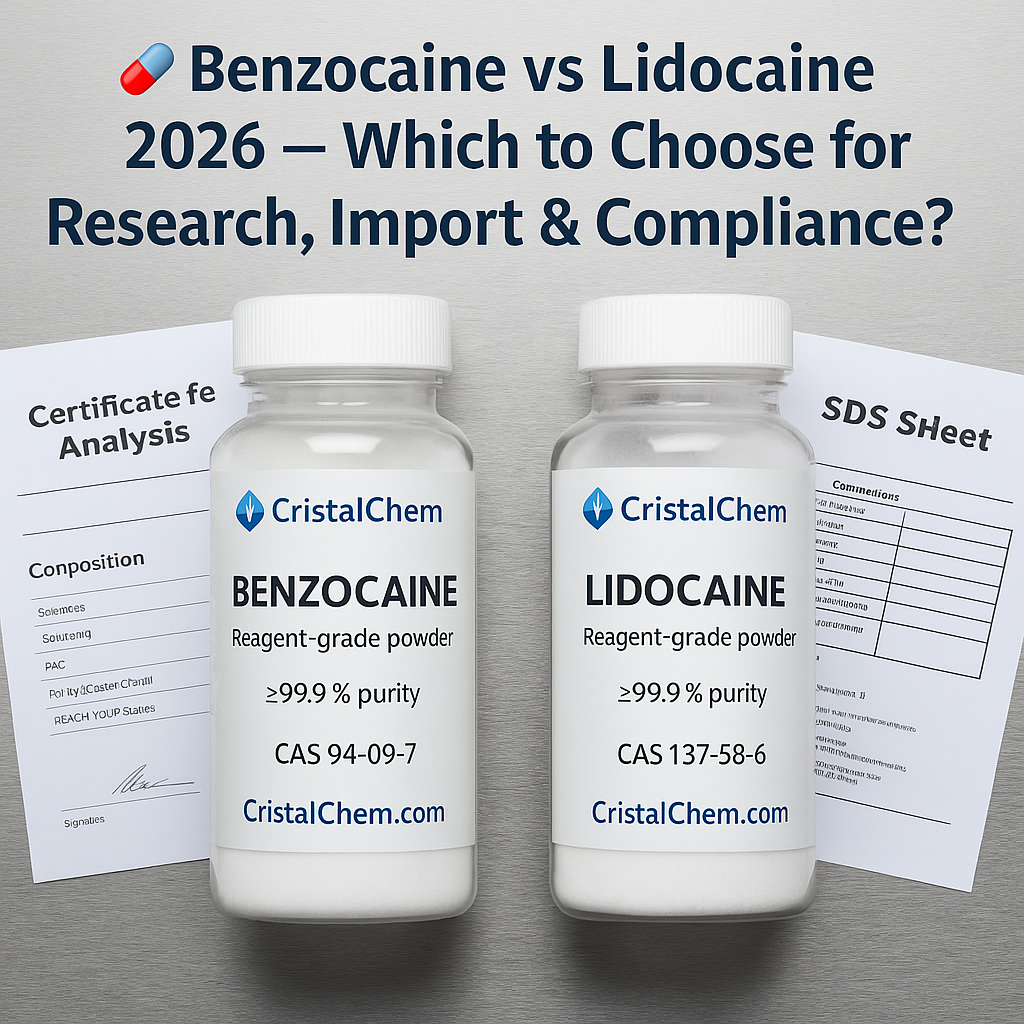
Although both are local anaesthetics, they differ significantly in their molecular structure and solubility profile. Benzocaine (CAS 94-09-7) is the ethyl ester of p-aminobenzoic acid, while Lidocaine (CAS 137-58-6) is an amide-based compound derived from diethylaminoacetic acid. Therefore, Benzocaine is less soluble in water but provides a faster onset in certain topical systems, while Lidocaine offers longer duration and better pH stability.
| Property | Benzocaine | Lidocaine |
|---|---|---|
| Chemical Class | Ester | Amide |
| Solubility | Low (water), high (ethanol) | High (water and ethanol) |
| pKa | 2.5 | 7.9 |
| Purity (CristalChem) | ≥99.9% | ≥99.9% |
| REACH / CLP Status | Registered | Registered |
For more detail about Benzocaine’s chemical identity and purity testing, see 🧪 What Is Benzocaine Powder?. Likewise, for the amide-class analysis of Lidocaine HCl, refer to 💊 What Is Lidocaine HCl Powder?.
In 2026, Benzocaine remains more cost-effective for general laboratory use due to simpler synthesis and a robust supply chain from EU-registered producers. Lidocaine HCl, however, often commands a higher price per kilogram because of its higher solubility, pH buffer compatibility, and broader research applications.
Accordingly, the price gap between the two reagents typically reflects their purification process and import category (HS 29242990 for Benzocaine vs 29224985 for Lidocaine). Therefore, research institutions seeking a neutral test base or prototype anaesthetic formulation often choose Benzocaine, while those running solubility or bioavailability tests prefer Lidocaine.
For a detailed pricing model, read 💸 How Much Is Benzocaine Powder? — DDP Guide 2026.
Because customs clearance has become increasingly complex post-Brexit and under new EU REACH obligations, CristalChem’s DDP (Delivered Duty Paid) delivery ensures full compliance and transparency. As a result, both Benzocaine and Lidocaine reagents arrive door-to-door, pre-cleared through customs with all required COA and SDS documentation included.
| Region | Lead Time | Shipping Terms |
|---|---|---|
| United Kingdom | 1 – 3 days | DDP |
| European Union | 1 – 3 days | DDP |
| USA / Canada | 3 – 6 days | DDP |
| Australia / Asia | 5 – 9 days | DDP |
See also 🇬🇧 Where to Buy Benzocaine in the UK — Verified Import Guide for details on door-to-door logistics.
Each reagent supplied by CristalChem includes a validated Certificate of Analysis (COA) and Safety Data Sheet (SDS). Because these documents are mandatory under both EU CLP and UK REACH, CristalChem ensures every batch is tested via ISO 17025-certified methods. Moreover, every shipment includes traceable HPLC purity data and batch number documentation.
💬 As highlighted in Benzocaine Market Outlook 2026, proper REACH compliance has become the deciding factor in reagent imports during 2026.
Benzocaine is best suited for topical anaesthetic testing, R&D formulation, and analytical chemistry projects requiring fast-acting but less water-soluble agents. Meanwhile, Lidocaine excels in water-based systems, prototype gels, and longer-duration numbing studies. Therefore, your choice should depend on solubility needs, formulation design, and analytical goals.
For instance, a lab developing a cream or gel will prefer Lidocaine HCl for its stability in aqueous matrices. Conversely, a team researching solid-state anaesthetic blends or solvent evaporation studies will find Benzocaine’s low solubility beneficial.
Explore detailed formulation data in 🧴 How to Use Lidocaine Powder — Lab Guide and 🧪 What Is Benzocaine Powder?.
⚠️ Disclaimer: All information provided in this article is intended solely for scientific, educational and research purposes! The data, specifications and analytical notes are based on laboratory literature and CristalChem R&D testing. CristalChem does not guarantee completeness or absolute accuracy of the information presented — users should independently verify all details before use in their own research environment. All reagents mentioned are strictly for laboratory and R&D applications only. Not for human or veterinary use!

Chemical Research Writer at CristalChem Academy. Passionate about chemistry, R&D, and turning laboratory insights into global wellness and industrial innovations.