GBP


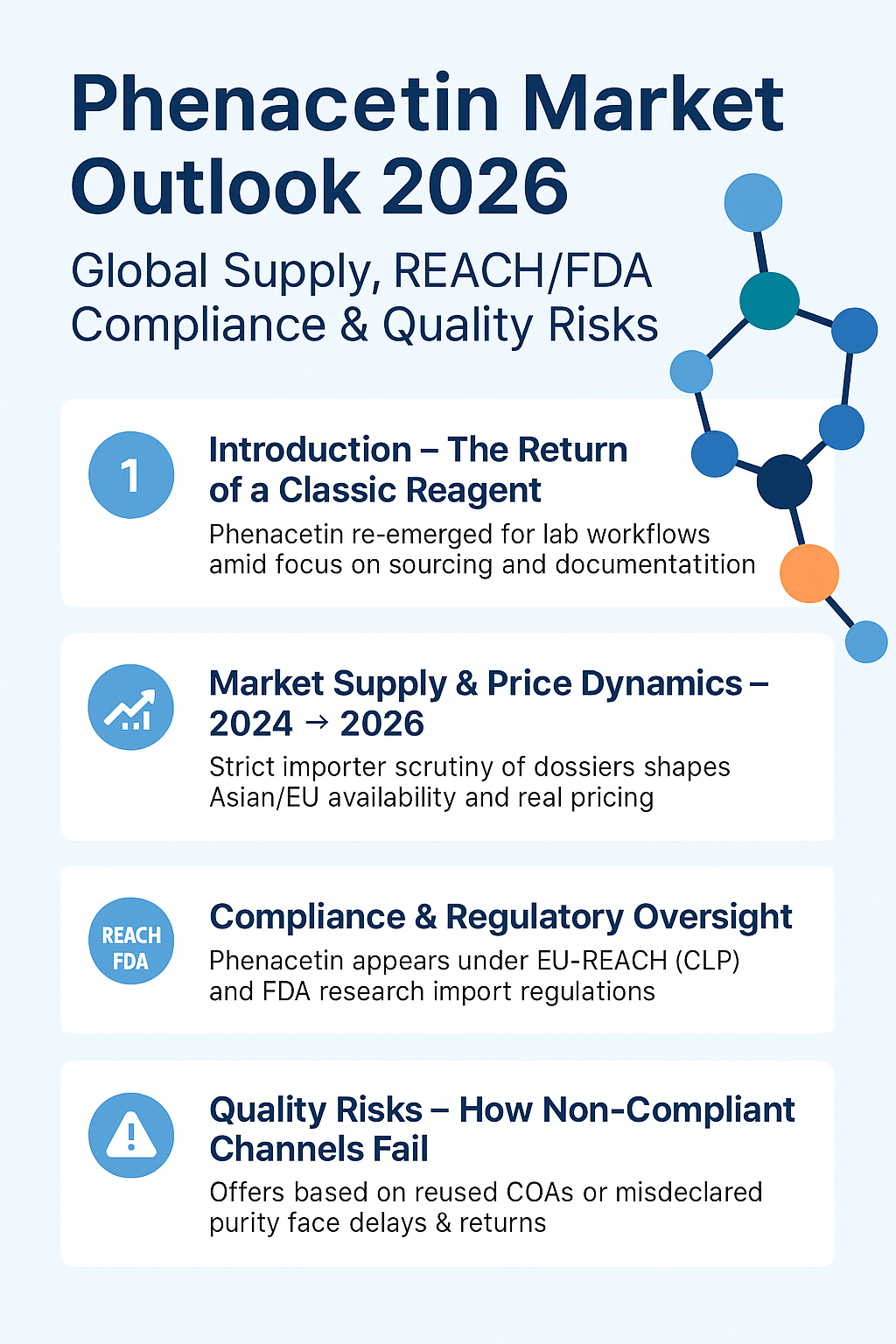
Phenacetin (CAS 62-44-2) has re-emerged in laboratory workflows as a reliable research-only reagent for solvent stability checks, recrystallization benchmarking, and method validation. Because global oversight keeps tightening, buyers now focus not only on price but also on documentation quality and provenance. Consequently, 2026 rewards verified sourcing and transparent dossiers far more than low headline offers.
Moreover, the market does not exist in isolation. It intersects with anesthetic-class reagents such as Benzocaine, Lidocaine, and Procaine. Therefore, cross-referencing trends helps predict availability and compliance risks. For wider context, see our hub piece on anesthetic reagents: Benzocaine Market Outlook 2026 — Pricing Drivers & REACH/CLP Risks.
As discussed in Benzocaine vs Lidocaine — Which to Choose, compliance and documentation often determine real-world lead time and total landed cost.
For identity checks, labs typically verify the COA against trusted databases. In particular, see the PubChem entry for a concise substance profile.
Overall, supply remains adequate; however, it is increasingly gated by documentation standards. Because consolidation among Asian intermediate plants continues, fewer exporters now meet EU/UK dossier expectations. As a result, compliant distributors gain share, while ad-hoc brokers lose traction.
Accordingly, market pricing in 2025 ticked up mainly due to compliance overhead, not because of synthesis complexity. Furthermore, we expect a similar pattern through 2026.
Before ordering, align your internal checklist with the current regulatory landscape. In the EU, Phenacetin appears in ECHA resources; consequently, labeling and SDS must follow CLP 1272/2008 (EU 2020/878 format). In the US, research imports fall under FDA oversight and must be declared correctly.
In practice, low-cost offers often reuse COAs or misdeclare purity. Consequently, customs or QA teams flag shipments, which leads to delays, re-testing, or returns. Therefore, confirm batch traceability, residual solvent data, and method references. Also, match SDS revision with label data to avoid discrepancies.
For impurity limits, rely on ICH Q3C(R8). This benchmark is widely adopted and, as a result, reduces disputes at audit time.
For a deeper compliance perspective, see Procaine HCl vs Lidocaine — Stability & Import Compliance 2026.
To reduce risk, choose suppliers that provide a consistent dossier: COA with HPLC assay, SDS aligned to CLP 2020/878, and a clear chain of custody. Additionally, prefer DDP routes when timing matters; in many cases, the total cost is lower than a patchwork EXW import with surprises.
⚠️ Disclaimer: All information provided in this article is intended solely for scientific, educational and research purposes! The data, specifications and analytical notes are based on available laboratory literature and internal R&D testing. CristalChem does not guarantee completeness or absolute accuracy of the information presented — users should independently verify all details before use in their own research environment. All reagents mentioned are strictly for laboratory and R&D applications only. Not for human or veterinary use!

Chemical Research Writer at CristalChem Academy. Passionate about chemistry, R&D, and turning laboratory insights into global wellness and industrial innovations.