
USD


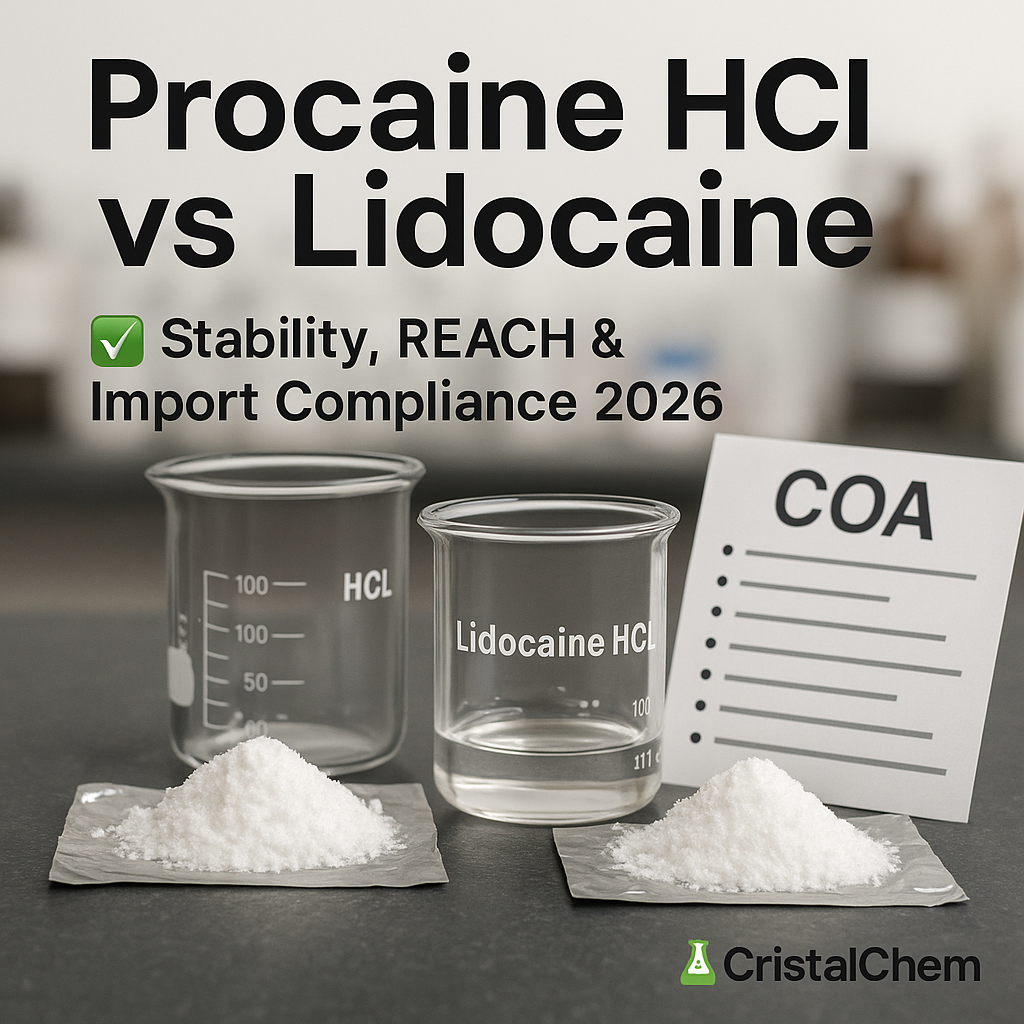
Procaine Hydrochloride (Procaine HCl) and Lidocaine Hydrochloride (Lidocaine HCl) are cornerstone local anesthetic actives for laboratory R&D, OEM development, and analytical benchmarking. Although both aim to deliver topical anesthesia, they differ in chemistry (ester vs amide), stability, solubility, and—critically—compliance & import documentation. Therefore, choosing the right active for 2026 depends as much on regulatory fitness as on lab performance.
As outlined in What Is Lidocaine HCl Powder — Forms & Specs, tight documentation (COA + SDS + traceability) drives compliant sourcing decisions.
| Attribute | Procaine HCl | Lidocaine HCl |
|---|---|---|
| Chemotype | Ester local anesthetic (para-aminobenzoate derivative) | Amide local anesthetic (acetanilide derivative) |
| CAS (salt) | 51-05-8 (base: 59-46-1) | 6108-05-0 (base: 137-58-6) |
| Water solubility | High (HCl form) | High (HCl form) |
| pKa (base) | ~8.9 | ~7.8–8.0 |
| Hydrolysis risk | Higher (ester cleavage) | Lower (amide stability) |
| Typical use-case | Legacy ester comparisons, analytical benchmarks | Modern gels/creams, hydroalcoholic systems |
Because ester linkages hydrolyze faster than amide linkages, Procaine often demands tighter control of moisture, pH, and storage. Conversely, Lidocaine HCl tends to be more robust across neutral and mildly acidic media, which simplifies gel and spray prototyping.
For process tips (carbomer/HEC selection, neutralization windows), see How to Use Lidocaine Powder in Creams & Gels — SDS & Lab Tips.
Whether you select Procaine or Lidocaine, a compliant shipment must include:
CristalChem provides batch-level COA + SDS and maintains a documentation archive for audit readiness.
2026 brings stricter scrutiny of anesthetic actives across the EU, UK, and US. Consequently, origin transparency and document integrity now shape whether a lot clears customs smoothly.
Because many low-price offers skip proper REACH status or circulate recycled COAs, they look attractive upfront yet cause downstream delays or rejections. A clean dossier wins.
Delivered Duty Paid (DDP) consolidates freight, customs brokerage, tax/duty, and last-mile into a single, insured route. As a result, the quoted figure may be higher than EXW/FOB, yet the shipment is “landed and legal” for QA. For time-sensitive R&D, DDP removes guesswork and post-factum costs.
For a breakdown by pack size (1–5–25 kg) and compliance overhead, read Lidocaine HCl Price by Pack Size — DDP Guide.
| Scenario | Procaine HCl | Lidocaine HCl |
|---|---|---|
| Water-based gel/spray | Works, but check ester stability | Preferred — robust and simple dissolution |
| Oil-heavy cream/ointment | Good fit for ester benchmarking | Works; often outperformed by Procaine in oily bases |
| Longer shelf-life target | Monitor hydrolysis closely | Advantage — amide stability |
| Strict audit environment | Possible — if dossier is strong | Common choice — broad OTC/regulatory familiarity |
Because red flags often surface only at customs or QA release, insist on pre-dispatch documentation and batch traceability. It costs less than re-shipping or re-testing.
For legitimate laboratory R&D, select suppliers that provide batch COA, SDS, and verifiable origin. CristalChem offers reagent-grade anesthetic actives with documented compliance and controlled delivery routes.
⚠️ Disclaimer: All information provided in this article is intended solely for scientific, educational and research purposes! The data, specifications and analytical notes are based on available laboratory literature and internal R&D testing. CristalChem does not guarantee completeness or absolute accuracy of the information presented — users should independently verify all details before use in their own research environment. All reagents mentioned are strictly for laboratory and R&D applications only. Not for human or veterinary use!

Chemical Research Writer at CristalChem Academy. Passionate about chemistry, R&D, and turning laboratory insights into global wellness and industrial innovations.