
USD

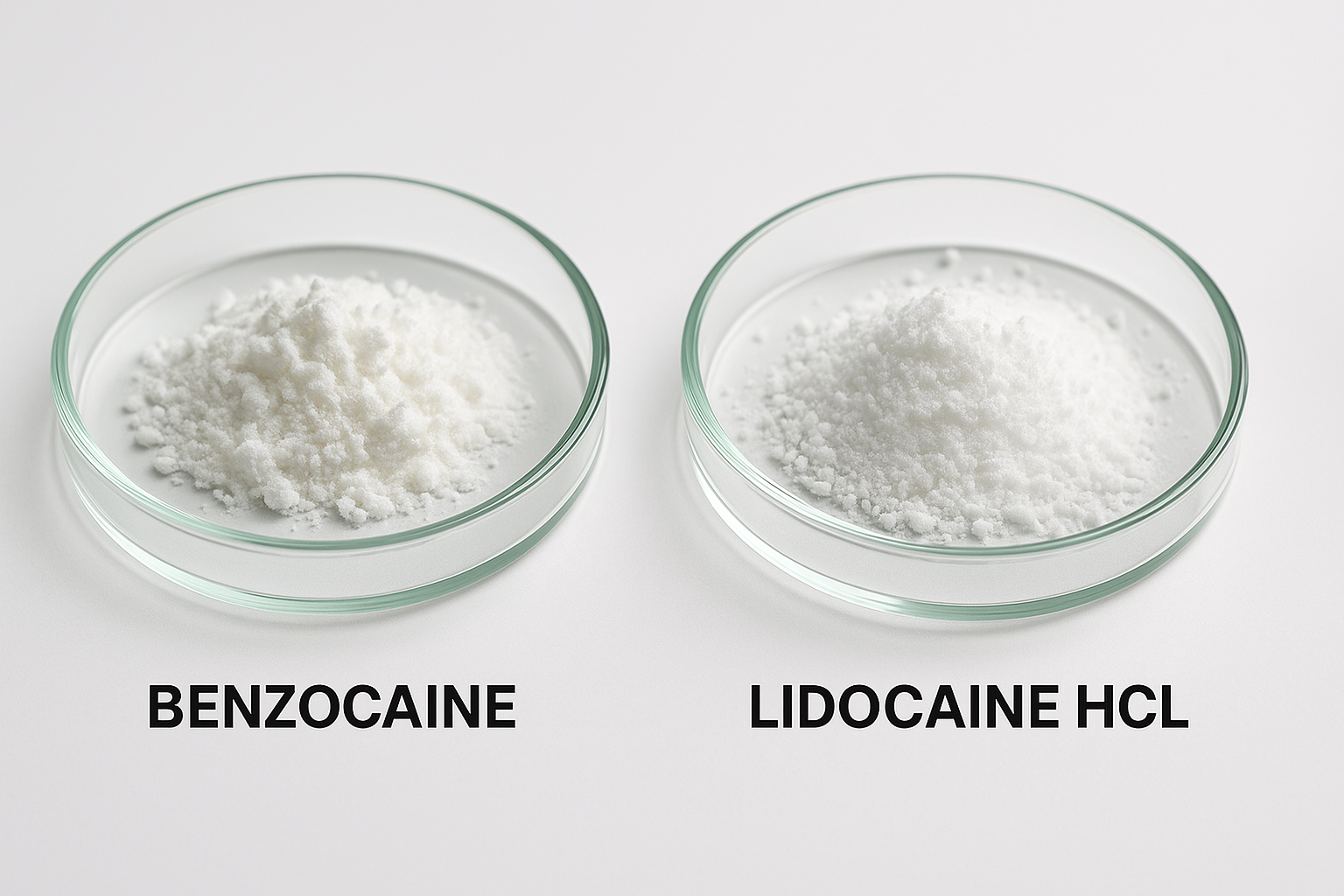
Among all local anesthetic actives, Benzocaine and Lidocaine HCl remain the two most widely researched and applied substances in both cosmetic and laboratory R&D fields. Though chemically related, they differ in solubility, onset, and regulatory status — making the question “which to choose” relevant for every formulator, chemist, or compliance officer.
In this comparative guide, we will analyze their physical properties, pharmacopoeial identity, practical lab behavior, documentation requirements, and market logistics. We will also provide links to CristalChem Academy resources and regulatory insights to help you make an informed decision for 2025/2026.
As discussed in our article on Lidocaine HCl Powder, documentation integrity and purity testing (COA + SDS) are decisive for compliant R&D sourcing.
Benzocaine (ethyl 4-aminobenzoate) is an ester-type local anesthetic, while Lidocaine (2-(diethylamino)-N-(2,6-dimethylphenyl)acetamide) belongs to the amide family. This structural difference affects their hydrolysis stability, water solubility, and pKa — ultimately influencing how they behave in formulations.
| Property | Benzocaine | Lidocaine HCl |
|---|---|---|
| Chemical Type | Ester | Amide (hydrochloride salt) |
| CAS | 94-09-7 | 6108-05-0 |
| pKa | 3.5–4.5 | 7.8–8.0 |
| Water Solubility | Poor (base form) | Freely soluble (HCl form) |
| Onset | Slower | Faster |
| Duration | Moderate | Longer-lasting |
| Stability (pH 4–6) | Lower | High |
Because Benzocaine is non-ionic and poorly soluble in water, it often requires co-solvents or surfactants in emulsions. Lidocaine HCl, in contrast, dissolves directly in water, simplifying the formulation process for gels, sprays, and aqueous bases.
Both actives appear in major pharmacopoeias (USP, Ph. Eur., BP) but differ in grade and classification. PubChem and Lidocaine HCl data confirm standard monograph parameters.
As shown in Lidocaine HCl Price by Pack Size — DDP Guide, documentation and import compliance (REACH/CLP) significantly affect landed cost and clearance time.
While both substances are considered low-toxicity actives, only Lidocaine HCl holds broader FDA OTC monograph coverage. Benzocaine, in contrast, faces increased scrutiny under FDA methemoglobinemia risk advisories (2018–2024). Always verify classification via:
Lidocaine HCl dissolves readily in water and ethanol, enabling aqueous and hydroalcoholic gels. Benzocaine, however, dissolves poorly in water but is soluble in ethanol, propylene glycol, and lipophilic bases. As a result, it performs better in oily creams or ointments.
Our guide on using Lidocaine powder in creams & gels highlights the importance of buffer systems and pH adjustment for optimal performance.
Both Benzocaine and Lidocaine are widely produced, but logistics and regulatory documentation quality differ significantly. Benzocaine supply is more fragmented and often originates from small-scale facilities in Asia without complete REACH registration. Lidocaine HCl supply is dominated by large-scale GMP facilities with established export documentation and pharmacopoeial traceability.
Verified reagent-grade forms are available through CristalChem Reagents, which maintain full COA + SDS archives and controlled DDP delivery to EU, UK, and USA destinations.
| Criterion | Benzocaine | Lidocaine HCl |
|---|---|---|
| Best for | Oil-based creams, ointments, research on esters | Water-based gels, sprays, cosmetic prototypes |
| Solubility | Poor in water | Freely soluble in water |
| Regulatory status | Limited OTC coverage | FDA monograph inclusion |
| REACH registration | Variable | Commonly registered |
| Ease of use | Requires co-solvent | Direct dissolution |
Ultimately, Benzocaine and Lidocaine HCl each serve distinct roles in modern R&D. Benzocaine remains ideal for oil-based, ester-focused systems, while Lidocaine HCl dominates aqueous and compliance-driven projects. Your choice depends on formulation medium, regulatory pathway, and target region. In both cases, working with verified suppliers like CristalChem ensures analytical transparency and documentation integrity.
Buffering and polymer choices are discussed in our formulation guide.
For compliant sourcing paths, see Where to Buy Lidocaine HCl — Global Guide.
⚠️ Disclaimer: All information provided in this article is intended solely for scientific, educational and research purposes! The data, specifications and analytical notes are based on available laboratory literature and internal R&D testing. CristalChem does not guarantee completeness or absolute accuracy of the information presented — users should independently verify all details before use in their own research environment. All reagents mentioned are strictly for laboratory and R&D applications only. Not for human or veterinary use!

Chemical Research Writer at CristalChem Academy. Passionate about chemistry, R&D, and turning laboratory insights into global wellness and industrial innovations.