
USD

Boric acid remains one of the most trusted raw materials across laboratory, cosmetic and industrial manufacturing. With stable chemistry and non-volatile performance, it supports glass, ceramics, coatings, flame retardants and pH control systems. In this complete guide, you will discover how to buy high-purity boric acid safely, understand market trends, and comply with REACH and CLP rules in 2025 and beyond.
The boric acid market continues to grow steadily. Laboratories in Europe, North America and Asia-Pacific increase their demand for certified reagents. While global capacity expands, buyers prefer door-to-door delivery with transparent COA and SDS documentation. CristalChem maintains verified REACH registration and ships globally from EU-based warehouses.
For comparison with other regulated reagents, review Procaine HCl Overview and Lidocaine HCl Popularity in Europe — both show how compliance-first sourcing improves stability and export approval.
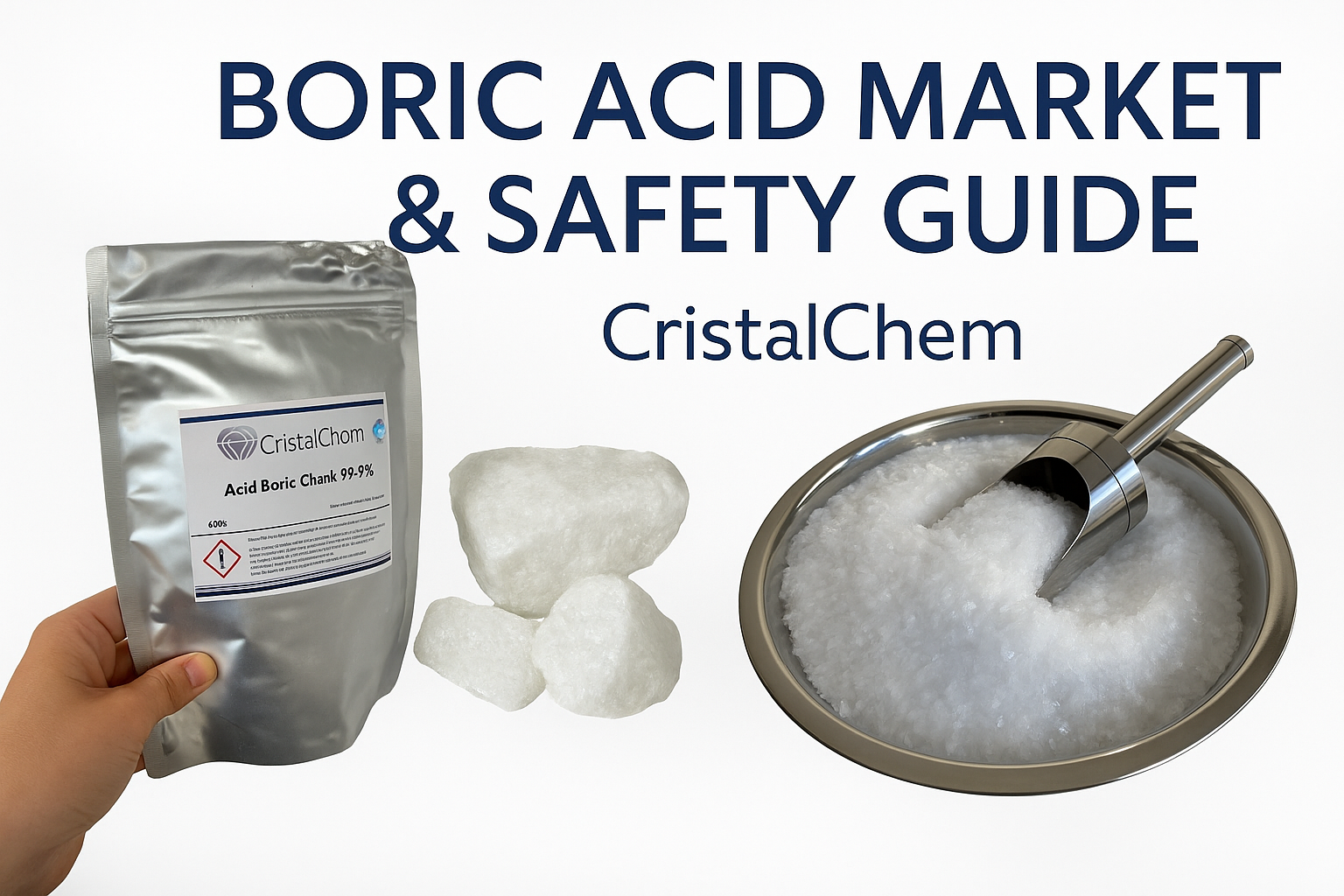
Scientists use boric acid flakes to stabilise buffers and reduce contamination. Because the product dissolves evenly, it supports precise titrations and analytical work. Moreover, CristalChem provides 99.9% purity confirmed by HPLC. You can find details inside every COA, including trace-metal profile and loss-on-drying results.
To understand how particle form affects reproducibility, see Benzocaine 50 Mesh Powder Guide — the same principle applies to boric acid morphology.
Industrial engineers rely on boric acid chunks in glass and ceramics because they melt evenly and control expansion. In cosmetic manufacturing, formulators use flakes to stabilise pH and maintain texture in emulsions. As a result, both small laboratories and global producers value its consistency.
For industrial R&D teams interested in solvent-free coatings, see Benzocaine Creams & Gels — Industrial Applications. It explains similar material compatibility across formulations.
Before ordering boric acid, verify three items: COA, SDS and REACH/CLP compliance. These documents ensure the reagent meets EU safety rules and can legally ship worldwide. CristalChem includes digital and printed documentation with every order. To learn how to read these forms efficiently, check Safety Data Sheet — How to Read and Apply.
Buyers in regulated markets such as pharmaceuticals or electronics often request batch consistency. Because we label every package with traceable lot numbers, audits and certifications proceed smoothly. For another example of detailed compliance management, see Benzocaine & Lidocaine — Customs Compliance.
Market pricing for high-purity boric acid depends on packaging size and delivery region. At CristalChem, prices start from competitive laboratory-grade rates. Exact values always appear directly in your cart with real-time delivery times. UK and EU deliveries arrive in 1–3 days, while USA, Canada and Asia–Pacific receive orders within 3–6 days.
For reference, see the pricing strategy for similar reagents at Benzocaine Price — Trends. It outlines how compliance and supply chain control protect quality while stabilising cost.
CristalChem packs boric acid in anti-static moisture-proof bags. Standard pack sizes include 1 kg, 5 kg, 10 kg and 25 kg. Each pack includes QR-coded COA and SDS reference links. In addition, our logistics teams support door-to-door DDP and DAP delivery, simplifying customs for laboratories worldwide.
If you work with multiple reagent types, read Lidocaine Crystalline Powder — it demonstrates how sealed, humidity-controlled packaging prevents degradation, exactly like our boric acid containers.
⚠️ Disclaimer: All information provided in this article is intended solely for scientific, educational and research purposes! The data, specifications and analytical notes are based on available laboratory literature and internal R&D testing. CristalChem does not guarantee completeness or absolute accuracy of the information presented — users should independently verify all details before use in their own research environment. All reagents mentioned are strictly for laboratory and R&D applications only. Not for human or veterinary use!

Chemical Research Writer at CristalChem Academy. Passionate about chemistry, R&D, and turning laboratory insights into global wellness and industrial innovations.