
USD


This updated guide uses plain, practical language. It explains how to use Levamisole Hydrochloride (CAS 16595-80-5) as a research-only reagent in 2026. Moreover, it gives you a simple mechanism overview, an easy compliance checklist (COA, SDS, REACH/CLP), and clear steps for analytical standardization. As a result, your lab can work faster, reduce re-qualification, and keep audits smooth.
Reading time: ~18 minutes • Updated: 18 Oct 2025 • Audience: R&D labs (pharma, veterinary, immunology), QC/QA teams, procurement
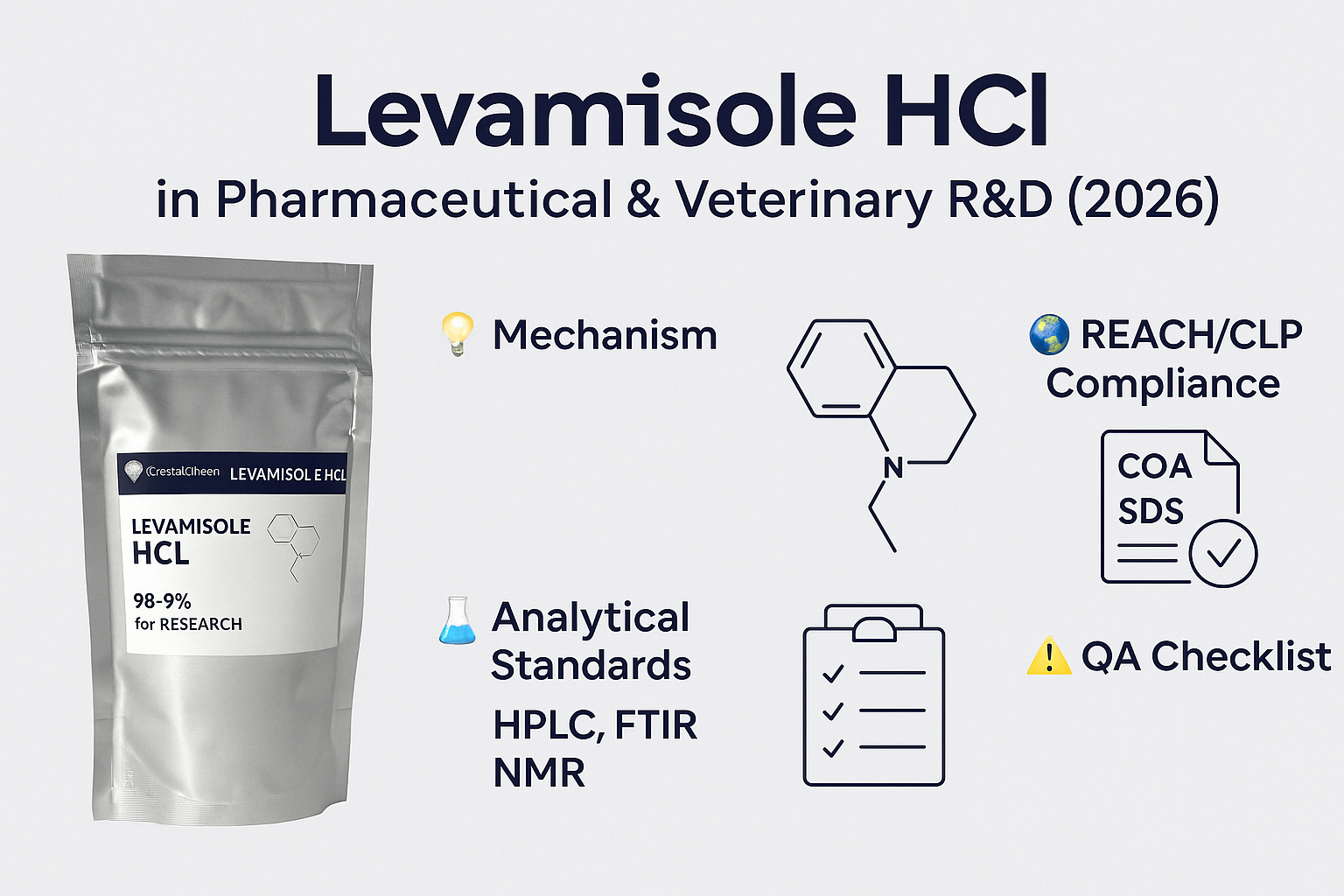
Levamisole HCl remains a reliable small molecule for two reasons. First, it is a classic anthelmintic comparator in veterinary research. Second, it is an accessible immunomodulatory probe in immunology. Because both areas value repeatable results, teams need consistent quality, stable documentation, and predictable shipping. Therefore, request a current COA, a GHS/CLP-aligned SDS, and clear traceability for every lot.
For quick background, you can compare Levamisole with related actives. For instance, see the salt-behavior primer Lidocaine vs. Lidocaine HCl. In addition, review process hygiene in Benzocaine Recrystallization. Finally, for applications beyond Levamisole, check Procaine HCl Usage & Applications (2026).
Levamisole is a selective agonist at nicotinic acetylcholine receptors in nematodes. Consequently, sustained activation causes spastic paralysis. In screening assays, this clean mechanism produces reliable positive controls and helpful dose–response curves.
In mammalian research, Levamisole may modulate elements of the immune response. Because of that, immunology groups often use it as a comparator in cell-based models. However, keep the scope clear: this is research only. Thus, label experiments properly and follow your SDS at all times.
Physicochemical traits guide your methods. Therefore, LC methods usually apply reversed-phase gradients with volatile buffers. Meanwhile, GC may need derivatization. Additionally, a quick UV–Vis or FTIR identity check confirms lot-to-lot consistency before full runs.
For identifiers and physico-chemical notes that support validation, see Levamisole HCl: Properties & R&D Use.
Because customs teams check consistency, align the invoice, packing list, label, and SDS wording. As a result, you reduce holds and avoid re-inspection.
When Levamisole HCl serves as a reference, lock a primary lot and keep a sealed reserve. In addition, record opening dates, storage, and every weighing. This habit reduces drift and, consequently, protects your trends.
Use FTIR with a clear library match. Optionally, run 1H-NMR for structure. Meanwhile, record solvent, temperature, and delays, so future rechecks stay comparable.
For purity-assurance logic that ports well to Levamisole, review Verify Benzocaine Purity. Similarly, you can apply those steps to Levamisole COA and HPLC sets.
Regulatory details change, yet your approach can stay simple. Therefore, use this short list:
For risk patterns linked to third-country sourcing and border checks, see Legal & Safety Risks (China) and China Customs & Police Considerations. In addition, compare price dynamics across actives in Procaine HCl — Global Supply 2026.
Formulation practice for creams/gels and solvent choice appears in How to Use Lidocaine Powder — Lab Guide and, importantly, in UK Topical Anaesthetic Manufacturing.
99.9% Reagent
Available in 28 g / 500 g / 1000 g — starting from — includes COA, SDS, and REACH/CLP documentation. Door-to-door delivery.
CristalChem delivers worldwide (EU, UK, USA/Canada, Asia-Pacific, Other Europe) within 1–3 business days.
Comparator
28 g / 500 g / 1000 g — starting from — complete COA/SDS — stable crystalline form for QC workflows.
Global DDP/DAP options.
Salt Grade
28 g / 500 g / 1000 g — starting from — REACH/CLP docs; COA & SDS included — consistent batch-to-batch quality.
Fast delivery: 1–3 business days.
Reference
28 g / 500 g / 1000 g — starting from — COA & SDS ready — ideal for method development as comparator reagent.
Door-to-door worldwide.
Lab Standard
28 g / 500 g / 1000 g — starting from — COA/SDS — suitable for calibration and comparative analysis.
Global coverage: EU, UK, USA/Canada, APAC.
Which documents should we ask for before ordering?
Request a current COA (assay, impurities, moisture, ID) and a GHS/CLP-aligned SDS. In addition, confirm lot traceability and label consistency. As a result, customs and QA checks move faster. How do we standardize an LC method quickly?
Begin with RP-C18, pH 3–4 buffer, and an ACN gradient. Then set tailing, resolution, and %RSD targets. Finally, confirm identity by FTIR and, if needed, NMR or MS. Which Incoterm works best for small, urgent shipments?
DAP or DDP usually lowers dwell time and reduces brokerage steps. Consequently, the total landed cost may be lower than EXW or FOB for lab-scale consignments. Is this material intended for treatment?
No. All materials discussed here are for laboratory and R&D use only. Not for human or veterinary use.
All information provided in this article is intended solely for scientific, educational and research purposes! The data, specifications and analytical notes are based on available laboratory literature and internal R&D testing. CristalChem does not guarantee completeness or absolute accuracy of the information presented — users should independently verify all details before use in their own research environment. All reagents mentioned are strictly for laboratory and R&D applications only. Not for human or veterinary use!

Chemical Research Writer at CristalChem Academy. Passionate about chemistry, R&D, and turning laboratory insights into global wellness and industrial innovations.